Open-Cell Spray Foam for Airdrie Interior Walls & Ceilings
Light-density open-cell foam fills a cavity completely, seals air leaks and absorbs airborne noise in interior walls. It is vapour-open and takes on water, so in Airdrie's climate it only goes where a warm-side vapour barrier and a dry location are certain.
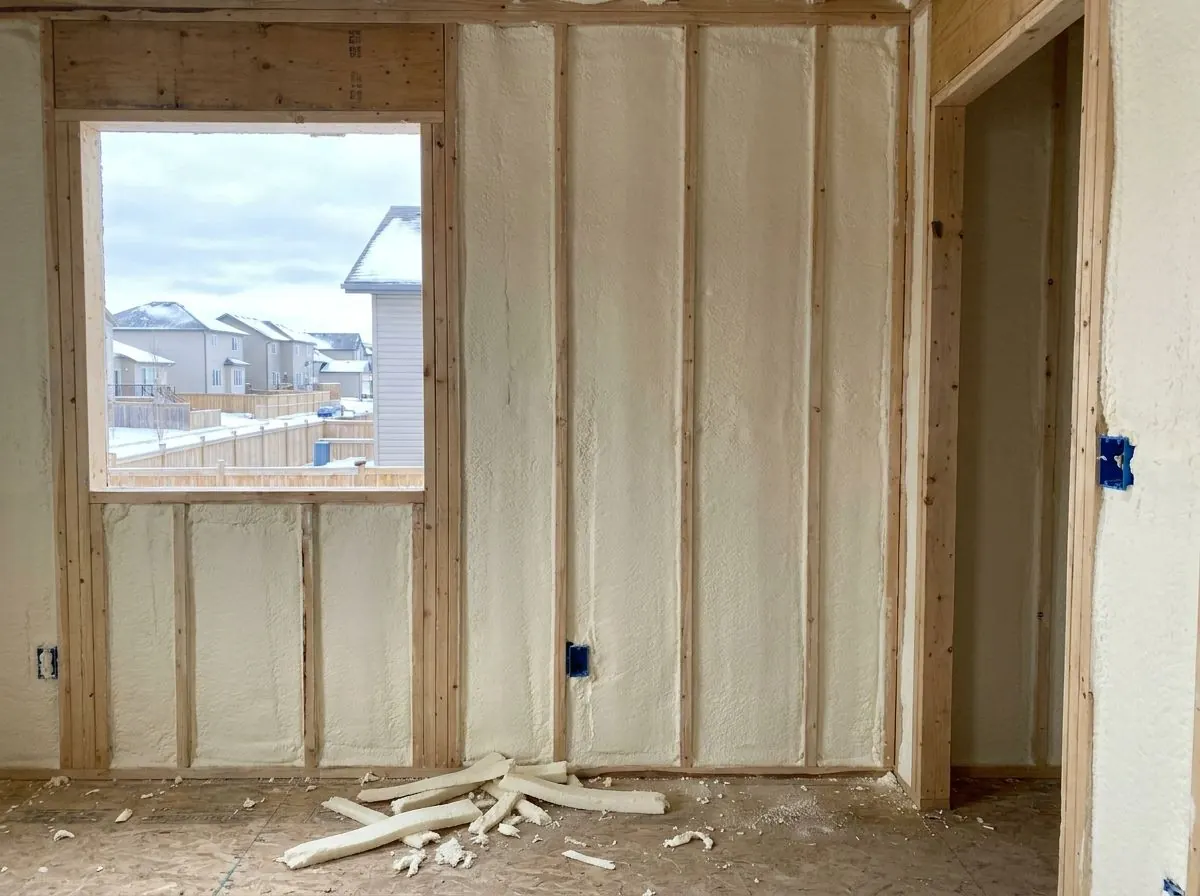
The Problem It Solves
Noise between rooms travels mostly through air. A home office beside a family room, a bedroom wall shared with a bathroom or a media room under a kitchen all leak sound through the hollow stud cavity, around outlet boxes and through gaps at the plates. Empty cavities resonate, and loosely fitted batts leave voids at wires and pipes that sound passes straight through. Homeowners who add insulation to a noisy wall are often disappointed, because the gaps, not the lack of material, were doing most of the damage.
Ceilings under a roof bring a different challenge. Vaulted and cathedral ceilings have shallow rafter bays, awkward angles and plenty of penetrations for pot lights and fans. Batts in those bays are hard to fit tight, sag away from the roof deck and leave the upper part of the bay poorly covered. Warm air leaking into those bays, pushed upward by the stack effect of a tall room, carries moisture into the roof assembly, where it can condense or frost on the cold underside of the sheathing.
Open-cell foam is often sold as the answer to both. It genuinely fills cavities and stops bulk air movement, but the second problem is where it gets misused. Open-cell foam lets water vapour pass through it. In a cold climate like Airdrie's, sprayed against a roof deck without a designed vapour control layer, it can let enough moisture reach the sheathing to cause frost, damp decking and eventually rot. Knowing that limit is the difference between a good open-cell job and an expensive roof repair.
How It Works
Half-pound open-cell spray foam cures into a soft, spongy material of broken cells, about 8 kg/m³ in place. It expands to many times its liquid volume, so a light spray fills a stud bay from side to side and wraps wires, pipes and box edges without the voids that batts leave behind. It commonly rates about R-3.5 to R-3.8 per inch depending on the product, so its value is not raw R-value. Its value is complete fill and air sealing in one step, and at sufficient thickness it acts as an air-impermeable layer.
In interior walls and floors, that complete fill makes the cavity absorptive and airtight, which helps with mid- and high-frequency airborne noise such as voices and television. It is not a mass layer, so on its own it does little against bass or footsteps; those need drywall mass, decoupling and floor-side work. For ceilings under a roof, open-cell only makes sense as part of an assembly designed for climate zone 7A, with a continuous, sealed vapour barrier or retarder on the warm side and a roof design reviewed for condensation risk. Where that design is not in place, we recommend closed-cell foam or a vented assembly instead.
How the Job Runs, Step by Step
Confirm the assembly before pricing
We ask what the wall or ceiling is for and what is on the other side of it. Interior partitions are straightforward. Any ceiling under the roof, or any wall facing outdoors, gets a check of the vapour control plan, roof venting and the drawings, if a permit is involved, before open-cell is quoted at all.
Protect finishes and isolate the room
Open-cell foam expands quickly and a long way, so windows, floors, neighbouring drywall and electrical boxes are covered. Ventilation exhausts vapours outdoors, and occupants stay away for the manufacturer's re-entry period.
Spray and slightly overfill each cavity
Foam goes in controlled passes within the manufacturer's limits and is usually allowed to rise a little proud of the studs so every corner and edge is filled. Around pipes, ducts and wiring bundles we slow down, because those are the routes that both sound and air follow.
Trim flush and look for voids
Once firm, the excess is cut flush with the framing, leaving a flat plane for drywall. Trimming exposes the cross-section of every bay, so hollow spots, shrinkage and poorly filled corners become visible and can be re-sprayed before the wall is closed in.
Vapour control, sealing and board
Where the assembly needs it, a sealed 6-mil poly or an accepted vapour retarder goes on the warm side, with laps sealed and electrical boxes detailed. Drywall then supplies the thermal barrier required over foam plastic, with acoustical sealant along the edges on sound walls.
What Decides the Specification
For sound, the rest of the wall decides the result more than the foam does. A full 2x4 or 2x6 cavity of open-cell foam makes a partition quieter, but the gain grows considerably when it is paired with resilient channel or sound clips, a second layer of drywall and sealed boxes. For heat, the effective RSI of a wall or ceiling is what counts under Section 9.36, and at under R-4 per inch open-cell rarely reaches a zone 7A ceiling target in a shallow rafter bay without extra depth or another layer.
Location is the gatekeeper. Open-cell foam absorbs liquid water and lets vapour through, so it is never used below grade, against concrete, on the exterior side of a building or anywhere it might get wet. In walls or ceilings separating heated space from outdoors, its use depends on a continuous warm-side vapour barrier and on a designer or the manufacturer confirming the assembly for our climate. Many Airdrie enquiries that start with open-cell end with closed-cell foam or a flash-and-batt system once those conditions are looked at honestly.
Alberta Code Notes
Light-density spray foam is covered by CAN/ULC-S712.1, the material standard, and CAN/ULC-S712.2, which sets installation requirements. Under the National Building Code - 2020 Alberta Edition, Section 9.25 requires a warm-side vapour barrier with a permeance of not more than 60 ng/(Pa·s·m²). Open-cell foam does not meet that by itself, so a separate layer such as 0.15 mm poly to CAN/CGSB-51.34 is typically needed wherever the foam sits in an exterior assembly. Article 9.10.17.10 requires foamed plastics in houses to be protected from the interior by a thermal barrier such as 12.7 mm gypsum board, or by a material tested and accepted with that foam.
For sound and fire separation between a secondary suite and the main dwelling, the code sets requirements and the permit drawings name the assembly that meets them. Open-cell foam can be part of that assembly only where the drawings or the authority having jurisdiction accept it; we do not substitute it for a specified batt without that approval. The same caution applies to fire-rated assemblies: the tested assembly shown on the drawings is the one that gets built.
General guidance only. The authority having jurisdiction and the product’s own evaluation report decide what applies to your job.
Around Airdrie
In Midtown, newer homes regularly get basement developments and suites, and owners often want a quieter home office, laundry wall or media room separated from the bedrooms. Interior partitions like those sit entirely inside heated space, which is where open-cell foam is on safe ground. In Bayside, larger two-storey homes with tall great rooms and vaulted ceilings bring up questions about foaming under the roof. Those roofs see rapid chinook warm-ups, and they are exactly where a vapour-open material needs a careful design, or a different material, rather than a quick spray.
Often Done Alongside
2lb Closed-Cell Spray Foam
2 lb foam: insulation, air barrier and vapour control for concrete and rim joists.
ROCKWOOL Safe’n’Sound Acoustic Batts
Safe’n’Sound batts for quieter interior walls, ceilings and floors.
Code-Compliant Vapour Barriers
Continuous 6-mil poly with sealed laps, plates and electrical boxes.
Where We Do This Work
Open-Cell Foam: Questions We Get
Why does open-cell foam need poly when thick closed-cell foam may not?
How much quieter will an interior wall be with open-cell foam?
Can open-cell foam be used in a cathedral ceiling in Airdrie?
Does open-cell foam shrink or pull away from the studs?
Can you insulate in the middle of an Airdrie winter?
Considering Open-Cell Foam?
Call Airdrie Insulation or send the details. We will look at the job, tell you whether open-cell foam is the right fix, and price it in writing.