2lb Closed-Cell Spray Foam Insulation in Airdrie
Medium-density closed-cell spray foam is the one insulation that is also an air barrier and, at about two inches, typically a vapour barrier. We spray it on concrete foundation walls, crawl space walls and rim joists, where cold surfaces and moisture rule out most other materials.
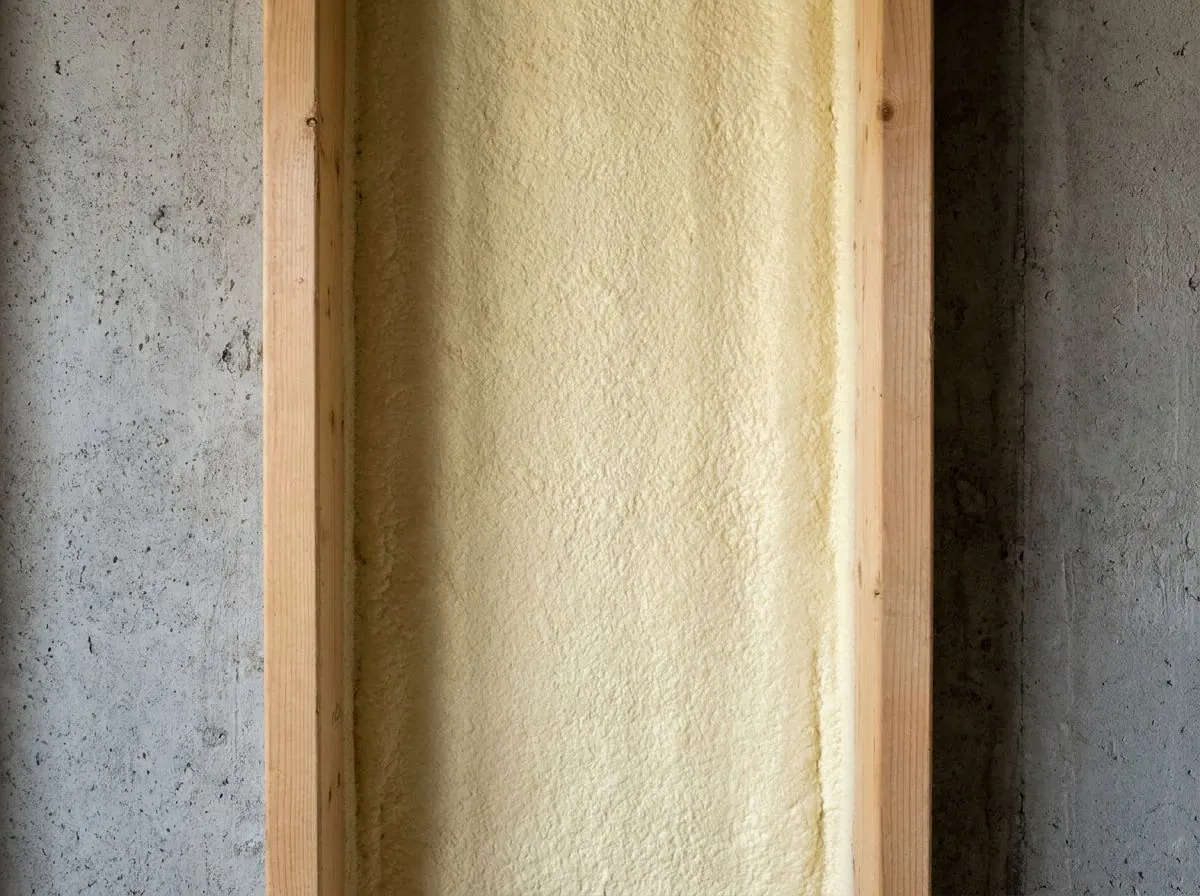
The Problem It Solves
Most insulation only slows heat. It does nothing about air, and in an Airdrie winter air is what carries the moisture. When warm indoor air slips past a batt and reaches a surface sitting near outdoor temperature, that vapour condenses or freezes on it. Concrete foundation walls above grade, rim joists and the walls of a crawl space are exactly those surfaces. Fibreglass pressed against them stays in contact with the cold, collects the moisture that sneaks around poly laps and electrical boxes, and gives mould a damp, dark place to start.
Concrete adds its own trouble. It is never completely dry: it wicks ground moisture and releases it slowly, so a stud wall framed tight against it can hold moisture in the bottom plate and the lower batts for years. The wood-framed header area, meanwhile, is chopped up by joists, blocking, wires, gas lines and dryer vents, so batts end up cut into pieces with gaps at every edge. The result is a basement that feels cold at the floor and rim joists that frost over in a cold snap.
The usual response is more material: thicker batts, another layer of poly. It rarely works, because the real faults are air movement and a cold condensing surface, and neither is fixed by adding fluffy insulation. These locations need a material that bonds to an irregular surface, fills every gap, stops air on its own and keeps the condensing surface out of reach of indoor air, without being harmed if it gets damp. That short list is why closed-cell foam is specified where it is.
How It Works
Two-pound closed-cell spray polyurethane foam is mixed at the gun from two liquid components and cures into a rigid plastic of tiny sealed cells, about 32 kg/m³ in place. Because it adheres to concrete, wood and steel, it seals the joints, cracks and ragged edges that batts leave open. The cells hold a low-conductivity blowing agent, so the material commonly delivers about R-6 to R-7 per inch, depending on the product and whether the figure quoted is the aged value. That is roughly twice what the same depth of fibreglass gives.
The foam is also an air barrier material, and at about 50 mm and thicker it typically meets the vapour barrier permeance limit, though the product's data sheet has to confirm that. So one layer does three jobs, insulation, air control and vapour control, all sitting tight against the cold surface. With no air gap behind it, indoor moisture never reaches the concrete or the rim board. It tolerates incidental water far better than fibrous insulation. The trade-off is that it is a combustible foam plastic, so wherever it faces occupied space it needs a thermal barrier over it.
How the Job Runs, Step by Step
Substrate check and moisture readings
We look at every surface before settling on a thickness. Concrete is checked for active leaks, efflorescence and damp patches, and wood is checked with a moisture meter, because foam sprayed over wet material seals that water in. Active foundation leaks get fixed first; we do not foam over them.
Masking and ventilation setup
Windows, floors, the furnace, water heater and anything not being sprayed are covered. Fans and temporary exhaust are set up to pull vapours outside during spraying, and the household stays out of the area for the full re-entry period the manufacturer sets.
Temperature control and daily field tests
Two-component foam is sensitive to temperature, so the drums, hoses and substrate are brought into the manufacturer's range. The installation standard calls for field checks each day, such as test sprays for cell structure, density and adhesion, recorded in the job file.
Spraying in controlled lifts
Foam is built up in passes no thicker than the manufacturer allows, with cooling time between them. One thick pass generates too much heat of reaction and can cause shrinkage, cracking or scorching. Thickness is probed as we go, especially at corners, around penetrations and at the tops of walls, where coverage tends to thin.
Clean-up, records and covering plan
Overspray is trimmed where framing or finishes need a flat face, and re-occupancy follows the manufacturer's time, commonly about a day. You receive the product and thickness records. Exposed foam then gets drywall or an accepted coating before the space is put to use.
What Decides the Specification
Thickness is set by what the foam has to do. On a rim joist, a few inches both insulates and seals. On a foundation wall where it will be the only vapour control, the product's permeance at a given thickness decides the minimum, commonly around two inches. Under a permit, the energy compliance path under Section 9.36 sets the effective RSI the whole assembly must reach, and the foam thickness is chosen to reach it with whatever framing and batt sits in front.
The substrate and the finish decide the rest. Concrete needs to be free of form oil, dust and loose paint; steel may need cleaning or primer as the manufacturer requires. The finish that will cover the foam is part of the specification from the start. In a developed basement that is usually a framed wall with drywall, while in a crawl space, mechanical room or shop it may be a coating listed for that exact foam. Planning the protection first avoids the common situation where foam goes in and nobody has budgeted for covering it.
Alberta Code Notes
Alberta enforces the National Building Code - 2020 Alberta Edition. Medium-density spray foam is manufactured to CAN/ULC-S705.1 and installed to CAN/ULC-S705.2, the installation standard that covers installer certification, site records and daily field testing. For houses, Section 9.25 governs insulation, air barrier systems and vapour barriers; a vapour barrier in a Part 9 building must have a permeance of not more than 60 ng/(Pa·s·m²). Energy performance for houses sits in Section 9.36, which counts effective RSI for the whole assembly, not the nominal value of the foam alone.
Article 9.10.17.10 requires foamed plastic insulation in houses to be protected from the interior by a thermal barrier, such as 12.7 mm gypsum board, or by another material or coating tested and accepted for use with that foam. Some attic, crawl space and rim joist situations are treated differently, and the foam's evaluation report and the inspector make that call. Whether a job needs a permit is decided by the authority having jurisdiction; in a basement development, the foam is part of that permitted work.
General guidance only. The authority having jurisdiction and the product’s own evaluation report decide what applies to your job.
Around Airdrie
In Woodside, homes built through the 1990s and 2000s commonly have rim joists that were stuffed with batts and covered in poly. Opening those up often shows dark staining on the rim board where moisture has been condensing every winter. Closed-cell foam is the material we reach for there. In the older homes of Crossfield, where crawl spaces and partial basements with rough concrete walls turn up more often, its ability to bond to an irregular surface and cope with a damp environment is the reason to use it at all. Chinook temperature swings make those cold surfaces cycle between frost and melt.
Often Done Alongside
Cold Basement Walls & Rim Joists
Closed-cell foam on rim joists and foundation walls for warm, dry basements.
Bonus Rooms Over Garages
Closed-cell foam under the subfloor to warm a freezing room over the garage.
Intumescent Thermal Barrier Coating
Paint-applied intumescent barrier over exposed foam, matched to that foam's listing.
Where We Do This Work
Closed-Cell Foam: Questions We Get
Does closed-cell foam lose R-value over time?
Can closed-cell foam go directly on bare basement concrete?
Is closed-cell spray foam safe to live with once it cures?
How thick should closed-cell foam be on a rim joist?
How do you work out what my home actually needs?
Considering Closed-Cell Foam?
Call Airdrie Insulation or send the details. We will look at the job, tell you whether closed-cell foam is the right fix, and price it in writing.