Insulation for North Calgary Homes, from Harvest Hills to Livingston
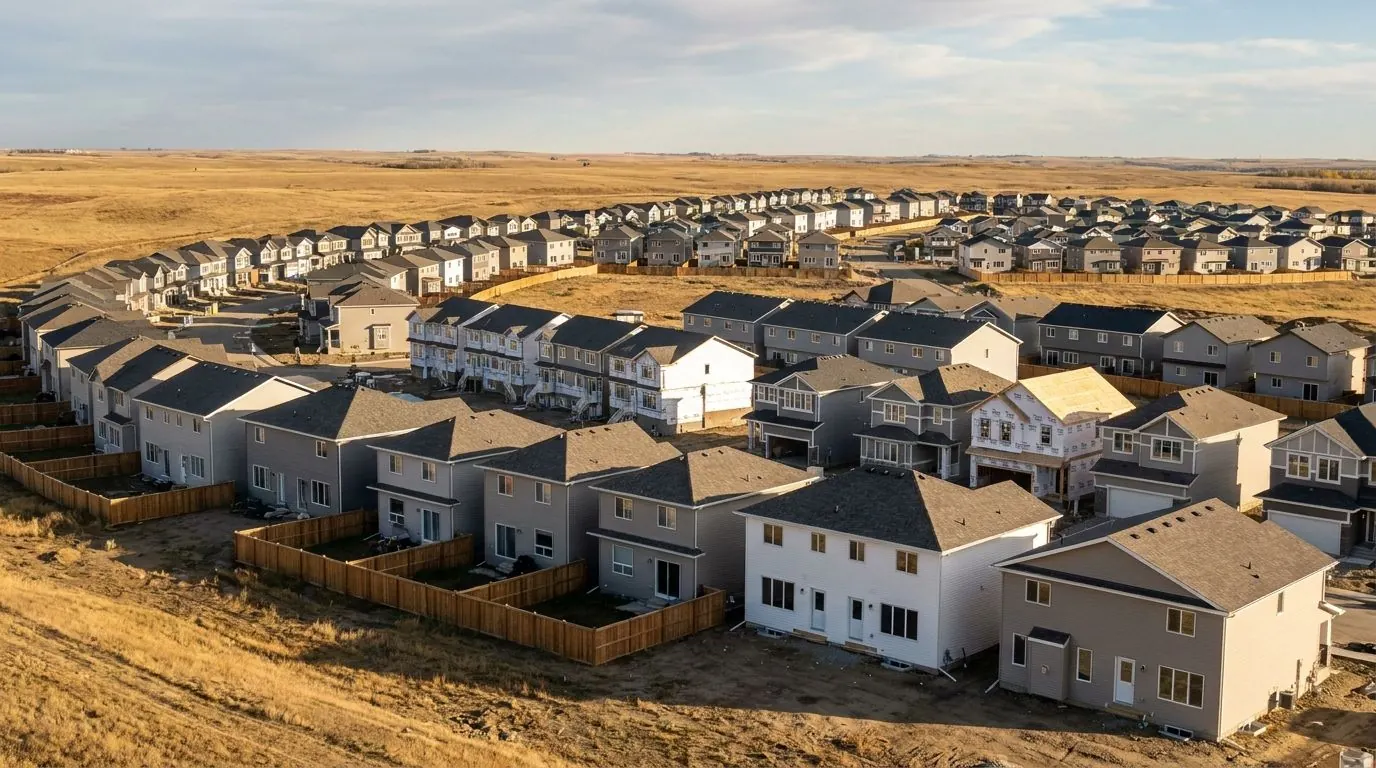
North Calgary is a short drive south of our Airdrie base on Highway 2, and its housing looks a lot like Airdrie’s: suburban two-storeys, attached garages and basements waiting to be finished. The difference is age. The communities along the north edge of the city span roughly three decades of building, and the insulation problems change as you move from the older hills to the newest streets.
At a Glance
- Permits issued by
- City of Calgary
- From our Airdrie office
- About 20-30 minutes south on Highway 2
- Postal prefixes
- T3P, T3K, T3R, T3N, T3J
The Homes and Buildings in North Calgary
The older part of this area is the band of communities around Harvest Hills, Coventry Hills and Panorama Hills, built largely through the 1990s and 2000s. Houses from that period commonly have attics insulated well below the roughly R-60 that current new-construction rules point to, bath fans whose ducts have come loose or were never run outside, and basements that owners developed on their own schedule. Rim joists stuffed with batts and covered in poly are typical, and so is poly that was cut for a new outlet or pipe and never resealed. These homes are often at the age where a roof replacement or a basement renovation is on the list anyway, which makes it a good time to fix the attic and the rim properly.
Farther out, communities like Evanston, Kincora, Sage Hill and Nolan Hill were built mostly through the 2000s and 2010s, and Livingston, Carrington and the northeast communities such as Redstone, Cityscape and Skyview Ranch are newer still, much of it from the 2010s into the 2020s. These houses were built to more recent energy rules, so the attic is rarely the first complaint. The common calls are cold bonus rooms over garages, basement developments where builder blanket insulation needs to be replaced or worked around, and secondary suites that need real sound isolation between the two units rather than whatever was left in the ceiling.
Neighbourhood Notes
Harvest Hills
One of the older communities on this list, largely built in the 1990s. Attics here commonly have settled insulation and unsealed penetrations, and a thermal imaging scan in winter tends to show a patchwork of cold ceiling areas. Air sealing and a top-up are the usual starting point.
Coventry Hills
Built largely through the 1990s and 2000s, with many two-storeys whose basements were finished by owners over the years. Rim joists covered with batts and poly are a frequent source of winter frost, and closed-cell foam at the header is the common fix.
Panorama Hills
A large hillside community built mostly through the late 1990s and 2000s. Homes on the higher, more exposed streets take more wind, which shows up at the eaves and in rooms over garages. Houses of this age are reaching the point where roofs get replaced, which is a sensible moment to check soffit vents and baffles.
Evanston and Kincora
Mostly 2000s and 2010s builds with bonus rooms over attached garages. Cold bonus-room floors are the most common complaint, usually caused by sagging floor batts and leaky rim and cantilever areas rather than too little insulation.
Sage Hill and Nolan Hill
Newer communities built mostly through the 2010s, with walkout basements on some of the sloped streets. As owners develop those basements, the transition between concrete and framed walkout walls needs careful detailing so the vapour barrier and air barrier stay continuous.
Livingston and Carrington
Some of the newest housing in the north, built largely from the late 2010s into the 2020s. The attic is rarely the issue. Basement suites, garage insulation and sound control between floors are the typical jobs.
Redstone, Cityscape and Skyview Ranch
Northeast communities built mostly through the 2010s, where plenty of owners are looking at adding a basement suite. The work here is usually sound isolation between the suite and the main floor, and dealing with shared ductwork that carries noise between the two.
Permits in North Calgary
Authority having jurisdiction: City of Calgary
Communities within Calgary city limits fall under the City of Calgary, which is the authority that issues building permits. A basement development or a secondary suite in Calgary needs a permit, and the insulation and vapour barrier in that work are part of what the permit covers, so they need to be installed and left accessible in line with the City’s process before the walls are closed. The City also decides whether a permit applies to other insulation work. If your suite plans include sound separation between units, the approved drawings name the assembly, and we build to what they specify.
What North Calgary Homes and Buildings Need Most
Bonus Rooms Over Garages
Closed-cell foam under the subfloor to warm a freezing room over the garage.
Secondary Suite Sound Isolation
Decoupled, sealed ceilings that cut noise between a basement suite and upstairs.
Cold Basement Walls & Rim Joists
Closed-cell foam on rim joists and foundation walls for warm, dry basements.
Attic Air Sealing & Penetration Proofing
Hand-sealing stacks, wiring holes, top plates, fixtures and flue chases.
Blown-In Cellulose Attic Top-Ups
Borate-treated cellulose blown over old attic insulation toward about R-60.
Insulation in North Calgary: Questions
Do you travel from Airdrie to work in north Calgary?
I am adding a basement suite in Skyview Ranch. What does insulation have to do with the permit?
My Panorama Hills attic gets frost in cold snaps. Is more insulation the answer?
Insulation Work in North Calgary?
Call or send the details. Airdrie Insulation works from Airdrie, and we will tell you what the job needs before we price it.