Insulating Airdrie Homes, Neighbourhood by Neighbourhood
Airdrie’s houses were not all built to the same standard, and they do not lose heat in the same places. An older bungalow near Old Town usually needs its attic sealed and topped up, while a two-storey from the 2010s is more likely to have a cold bonus room or a frosty rim joist. This page sorts the city’s housing by era and neighbourhood so you know what is typical on your street before anyone opens a ceiling.
At a Glance
- Permits issued by
- City of Airdrie
- From our Airdrie office
- Local
- Postal prefixes
- T4A, T4B
The Homes and Buildings in Airdrie
The oldest housing in Airdrie sits in and around Old Town and the Edmonton Trail corridor, with established areas such as Hillcrest and Big Springs built largely from the 1970s into the 1990s. Homes from that stretch were insulated to the expectations of their day. In the attic that commonly means thin fibreglass batts or loose fill that has settled well below its original depth, with little or no air sealing at the ceiling. Plumbing stacks, wiring holes through the top plates, recessed lights and bath fans that exhaust into the attic are the usual leaks. Some of these houses have had a top-up at some point and many have not, so we look before we quote. If the attic holds grey-brown or gold pebbles, that may be vermiculite; we stop, and it gets tested before anything is disturbed.
Neighbourhoods built through the 1990s and 2000s, Woodside being the clearest example, have a different pattern. The attics are better than the older core but were typically insulated well short of the roughly R-60 benchmark that current new-construction rules point to in this climate zone. The bigger issue is usually downstairs. Many of these basements were developed by owners over the years, one room at a time, and the rim joists were often filled with batts and covered with poly. That lets warm, moist house air reach the coldest wood in the house, and it shows up as frost on the header in January and staining or mould later. Poly that was torn for a new outlet and never resealed is also common.
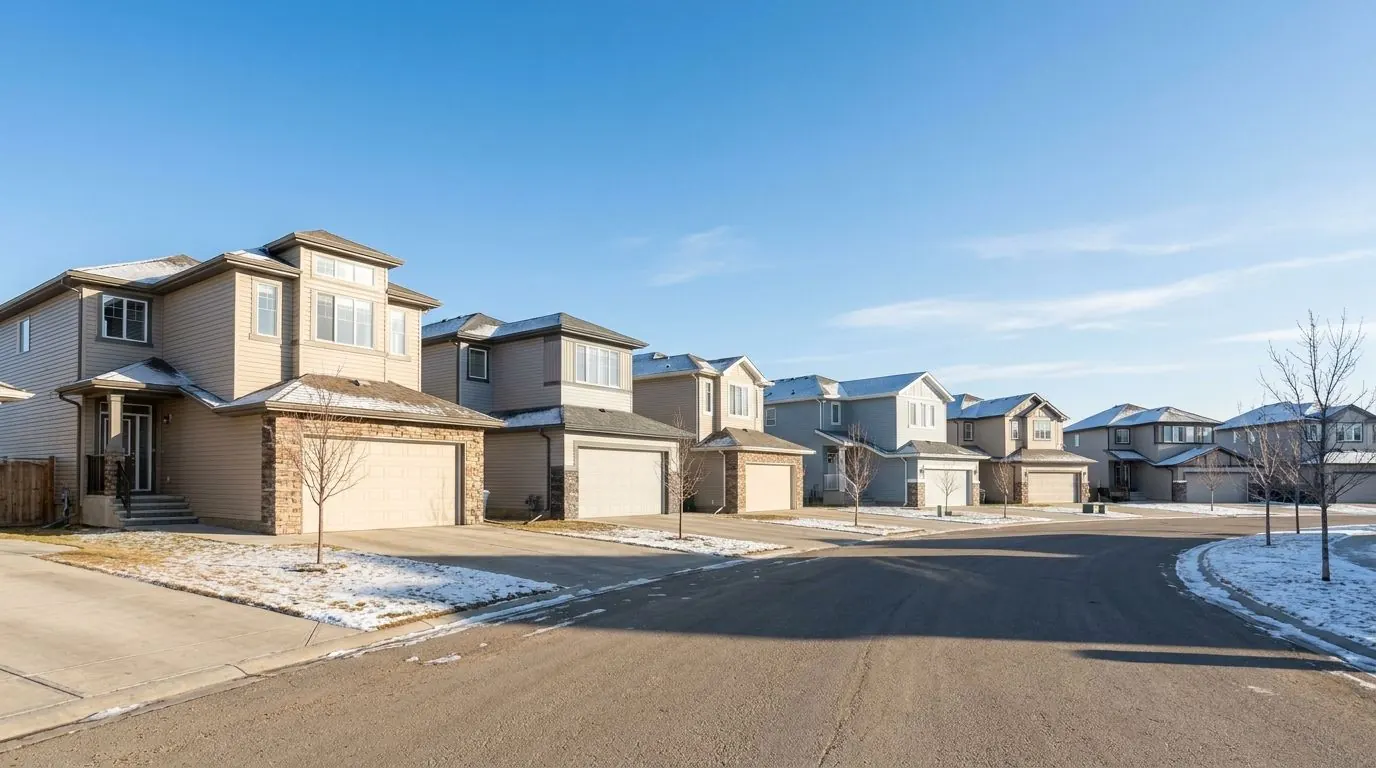
Most of Airdrie’s housing went up in the late 2000s and 2010s, in communities like Coopers Crossing, Kings Heights and Bayside, and building has continued in newer areas such as Midtown. These homes were built to more recent code editions, so the attic is rarely the headline problem. What we see instead are the gaps between trades: bonus rooms over attached garages where the floor batts have sagged away from the subfloor, builder blanket insulation on basement walls that stays in place long after the basement is finished around it, and owner-built secondary suites where nobody planned for sound between the two units. Newer does not mean trouble-free. It means the trouble has moved.
Neighbourhood Notes
Old Town and Downtown
The oldest houses in the city, many of them bungalows and small two-storeys with low attic space and a long history of renovations. Attics often have thin or mixed insulation layers and unsealed penetrations from decades of electrical and plumbing changes. We check for vermiculite and knob-and-tube wiring before recommending blown insulation or dense-pack walls.
Hillcrest
One of Airdrie’s older established neighbourhoods, where attics commonly hold settled cellulose or thin fibreglass and older windows let in noticeable drafts. These homes are good candidates for attic air sealing followed by a top-up, and a thermal imaging scan on a cold morning usually shows exactly where the ceiling is leaking.
Big Springs
An established area largely built before the city’s big growth years, with attics that were insulated to older standards and bath fans that do not always vent outdoors. Rerouting a fan duct and sealing around it is often part of an attic job here, because a fan that dumps into the attic feeds frost directly.
Woodside
Homes around the golf course, largely built through the 1990s and 2000s, with attics below today’s benchmark and basements that owners finished over time. The rim joists are the usual weak point: batts stuffed in behind poly, frost on the header in deep cold. Closed-cell foam at the rim fixes that in one step.
Coopers Crossing
A large southwest community built mostly through the late 2000s and 2010s. Many two-storeys here have bonus rooms over attached garages that run noticeably colder than the rest of the house, and many owners are now developing basements or adding suites, which makes rim joists, vapour barrier and sound control the common jobs.
Bayside
Larger two-storey homes along the canal system, built mostly through the late 2000s and 2010s. Lots that face open water catch more wind, which shows up as cold bonus-room floors and wind-washed insulation near the eaves. We look at the rim and cantilever above the garage and at the soffit baffles before recommending anything.
Kings Heights
A southeast community built mostly from the late 2000s through the 2010s, with bonus rooms over garages and many walkout or basement developments. Walkout walls are part foundation and part framed wall, and the transition between them is a frequent cold spot that needs careful air sealing and a continuous vapour barrier.
Midtown
One of Airdrie’s newer communities, built from the late 2010s onward close to downtown. Houses are recent code builds, so the attic is rarely the issue. The work here is usually finishing a basement properly, insulating a garage, or isolating sound for a permitted secondary suite.
Permits in Airdrie
Authority having jurisdiction: City of Airdrie
Inside city limits, the City of Airdrie is the authority that issues building permits. A basement development or a secondary suite needs a permit from the City, and the insulation and vapour barrier in that space are part of the work the permit covers, so they need to be done and left visible in line with that process. For other insulation work, such as an attic top-up or spray foam in a garage, the City decides whether a permit applies; we will tell you what we know, but the authority having jurisdiction has the final word. Be aware that plenty of rural properties with an Airdrie mailing address are not in the city at all. Those fall under Rocky View County, which has its own permit process.
What Airdrie Homes and Buildings Need Most
Bonus Rooms Over Garages
Closed-cell foam under the subfloor to warm a freezing room over the garage.
Ice Dam & Attic Frost Mitigation
Air sealing, soffit prep and an R-60 top-up to stop ice dams and attic frost.
Attic Air Sealing & Penetration Proofing
Hand-sealing stacks, wiring holes, top plates, fixtures and flue chases.
Blown-In Cellulose Attic Top-Ups
Borate-treated cellulose blown over old attic insulation toward about R-60.
Cold Basement Walls & Rim Joists
Closed-cell foam on rim joists and foundation walls for warm, dry basements.
Secondary Suite Sound Isolation
Decoupled, sealed ceilings that cut noise between a basement suite and upstairs.
Close to Airdrie
Warehouses, distribution bays and acreage homes just south of Airdrie.
Small-town homes, shops and farmyards north of Airdrie on Highway 2.
Evanston, Sage Hill, Panorama Hills, Coventry Hills, Livingston and nearby.
Acreages, pole barns, ag shops and rural homes surrounding Airdrie.
Insulation in Airdrie: Questions
My house is in Coopers Crossing and only a few years old. Why is the bonus room so cold?
Does the City of Airdrie need to be involved in my basement insulation?
Should I top up the attic in my older Hillcrest or Big Springs home or seal it first?
Insulation Work in Airdrie?
Call or send the details. Airdrie Insulation works from Airdrie, and we will tell you what the job needs before we price it.