Blown-In Cellulose Attic Top-Ups for Airdrie Homes
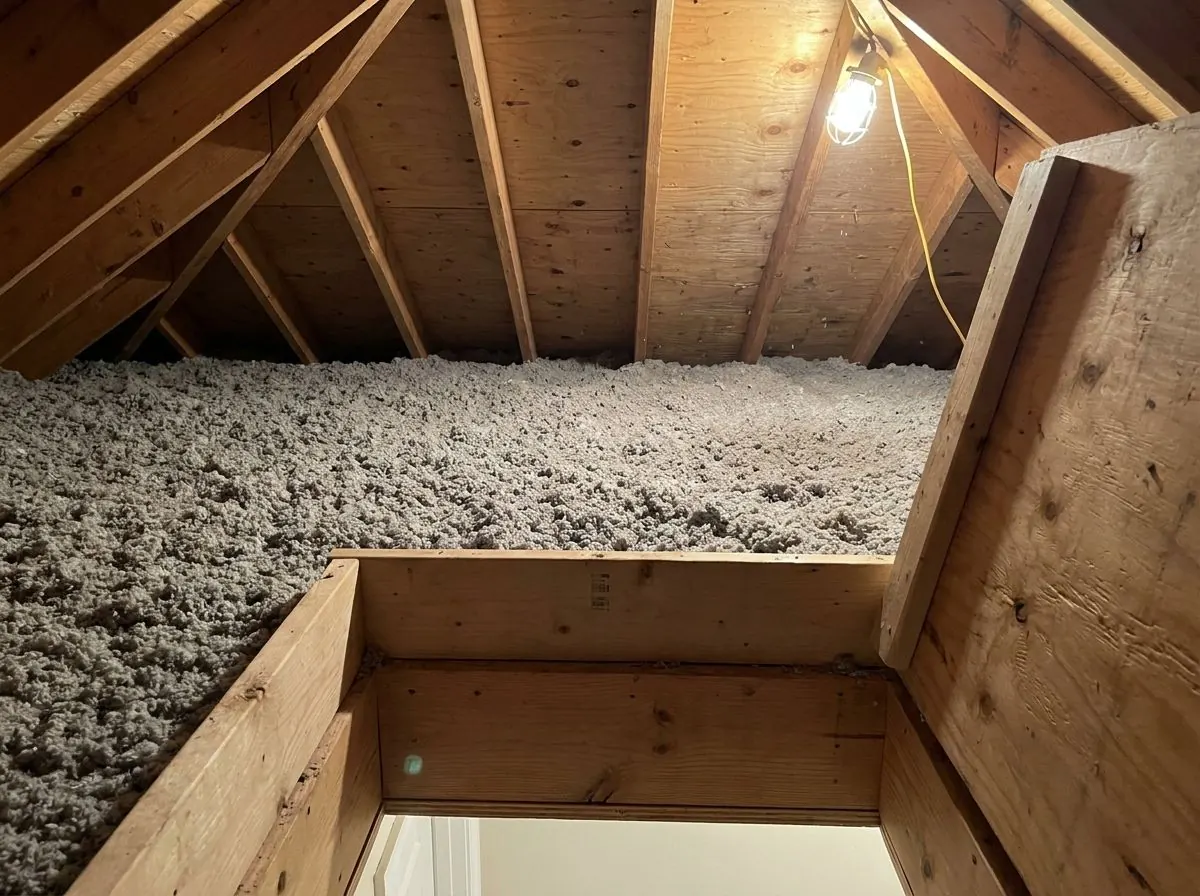
Cellulose is borate-treated recycled paper fibre blown over your existing attic insulation to bring the ceiling up toward about R-60. We blow it to the settled depth on the bag chart, not the fluffy depth on day one, and we tell you first if your attic needs sealing or venting work before any fibre goes in.
The Problem It Solves
Plenty of Airdrie attics were insulated to whatever the builder was required to install at the time, and that number was lower than today’s target. Add twenty or thirty years of settling, a few trips across the joists by the cable installer, and a hatch nobody ever put back properly, and the real coverage is thinner and patchier than the original paperwork suggests. You feel it as upstairs bedrooms that run cooler than the main floor, a furnace that cycles hard through January, and ceilings that stay cold to the touch around the outside walls.
The attic is usually the cheapest place in a house to add thermal resistance, because the space is open and nothing has to be torn out. But a thin attic is rarely just a thin attic. Warm air leaking up through light fixtures, plumbing stacks and top plates carries heat and moisture straight past the insulation, and fibre blown over those leaks simply hides them. In our climate that moisture turns into frost on the underside of the roof sheathing, which is a separate problem with its own page on this site.
The other common story is uneven depth. Loose fill piles up under the hatch where it was easy to reach and thins out toward the eaves, where the roof slope pinches the space down. The eaves sit above the exterior walls, which is exactly where the ceiling needs the most help. A top-up done by eye from the hatch tends to repeat that pattern instead of fixing it, which is why we measure across the whole attic before quoting depth.
How It Works
A cellulose top-up adds a continuous blanket over what is already there. The installer pulls the hose to the far corners first and works back toward the hatch, filling low spots and the eave area before building overall depth. Because cellulose is a dense, fine fibre, a deep layer resists air moving through it better than lighter loose fill, which helps on windy days when cold air pushes in at the soffits. Depth rulers stapled to trusses across the attic give you and any inspector a visible check on what was installed.
We blow to the settled depth for the R-value you are after, plus the settling allowance printed on the bag chart, and we count bags against the chart’s coverage figure for the attic area. That count matters more than eyeballing depth, because cellulose blown too light looks thick on the day and loses R-value as it settles. Before any of that, we check that soffit baffles are in place and that the obvious air leaks at the ceiling plane have been dealt with, because a thick layer of fibre makes both of those jobs far harder later.
How the Job Runs, Step by Step
Attic assessment and depth survey
We measure existing depth from hatch to eaves, identify the old material, and look for vermiculite, rodent activity, water staining, frost marks on the sheathing, and bath fans venting into the attic. If we find vermiculite, the job stops there until it is tested.
Prep: baffles, dams and leaks
Rafter vents go in at every soffit bay that needs one, a hatch dam goes around the opening so fibre does not spill into the house, and recessed lights or chimney chases get the clearances and covers they require. Where air sealing is part of the scope, it happens now, before the new layer covers the ceiling.
Protecting the house and setting markers
The blowing machine stays outside on the truck and the hose runs to the hatch with drop sheets along the route. Inside the attic we staple depth rulers to trusses at intervals so the finished depth can be read from the hatch without walking through the fibre.
Blowing to the settled target
The installer starts at the farthest eaves and works back, keeping the hose low to fill around framing and under wiring rather than bridging over gaps. Bags are counted as they go into the hopper and checked against the coverage chart for the attic’s area and the target R-value.
Final check and records
We read the rulers across the attic, confirm baffles are still clear at the eaves, reinstall and weatherstrip the hatch with rigid insulation on its back, and leave you with the installed depth, target R-value and bag count for your records.
What Decides the Specification
The target depth comes from the product, not from a rule of thumb. Different cellulose products have different densities and coverage charts, so the inches needed for about R-60 shift a little between them. We also account for what is already there: old, compressed fibreglass still counts, but not at its original label value. If the house has a heat-recovery ventilator, the Section 9.36 benchmark drops to about R-49, which some owners choose as their target instead.
The attic itself sets limits. Low-slope roofs leave very little room at the eaves, and there the rafter vent and the settled depth have to share the space. Ceiling drywall and framing spacing matter too: cellulose is heavier than loose fibreglass, so on ceilings with wide framing spacing or thin, already-sagging board, we look hard at whether fibreglass is the better fill. Attic access matters as well. A tiny hatch in a closet can still work, but it changes how the hose is run and how carefully the room below is protected.
Alberta Code Notes
Alberta enforces the National Building Code 2020 Alberta Edition, and Section 9.36 sets the energy efficiency requirements for houses. For climate zone 7A, which covers Airdrie and the surrounding area, the prescriptive ceiling-below-attic value is RSI 10.43, about R-60, for a house without an HRV, or RSI 8.67, about R-49, with one. Those are new-construction targets; an existing attic top-up is not legally required to reach them, but they are the sensible benchmark. They are also effective values, so framing and thin eaves count against you.
Section 9.19 governs attic ventilation, commonly requiring unobstructed vent area of at least 1/300 of the insulated ceiling area, split between soffit and roof vents, and insulation must not block the soffit airway. Cellulose itself is manufactured to CAN/ULC-S703. Whether a top-up needs a permit is a decision for the authority having jurisdiction, whether that is the City of Airdrie, Rocky View County or the town you live in, so we check rather than assume.
General guidance only. The authority having jurisdiction and the product’s own evaluation report decide what applies to your job.
Around Airdrie
Cellulose top-ups make the most sense in Airdrie’s older established areas, where attics have had decades to settle. In Hillcrest and Big Springs, many homes from the 1970s through the 1990s still carry their original attic fill, often a thin layer of fibreglass or old cellulose that has packed down unevenly and been disturbed around the hatch. Those attics are usually roomy enough to take a deep new layer. The same pattern turns up in older homes in Crossfield. Where we find rodent droppings or damaged fill, we recommend removal first rather than burying the problem.
Often Done Alongside
Attic Air Sealing & Penetration Proofing
Hand-sealing stacks, wiring holes, top plates, fixtures and flue chases.
Attic Venting & Baffle Prep
Rafter vents and wind dams that keep soffit-to-ridge airflow open.
Ice Dam & Attic Frost Mitigation
Air sealing, soffit prep and an R-60 top-up to stop ice dams and attic frost.
Where We Do This Work
Blown-In Cellulose: Questions We Get
Can cellulose be blown right over my existing fibreglass attic insulation?
How long does a cellulose attic top-up usually take?
Will blown cellulose make my house dusty inside?
Is borate-treated cellulose a fire hazard in an attic?
Can you insulate in the middle of an Airdrie winter?
Considering Blown-In Cellulose?
Call Airdrie Insulation or send the details. We will look at the job, tell you whether blown-in cellulose is the right fix, and price it in writing.