Ice Dams & Raining Attics in Airdrie: Stopping Attic Frost at the Source
Icicles thick as your arm, water stains at the ceiling edge, or drips from light fixtures the day a chinook blows in are attic problems, not roof problems. We stop the warm air leaking into the attic, restore soffit airflow and then top up the insulation.
The Problem It Solves
An ice dam starts as heat. When warm air and conducted heat reach the underside of the roof deck, snow on the roof melts from below even in freezing weather. The meltwater runs down to the overhang, which sits outside the heated house and stays cold, and it refreezes there. Each cycle builds the ridge of ice higher until water pools behind it and backs up under the shingles. Homeowners see heavy icicles, stained drywall at the ceiling edge and peeling soffit paint.
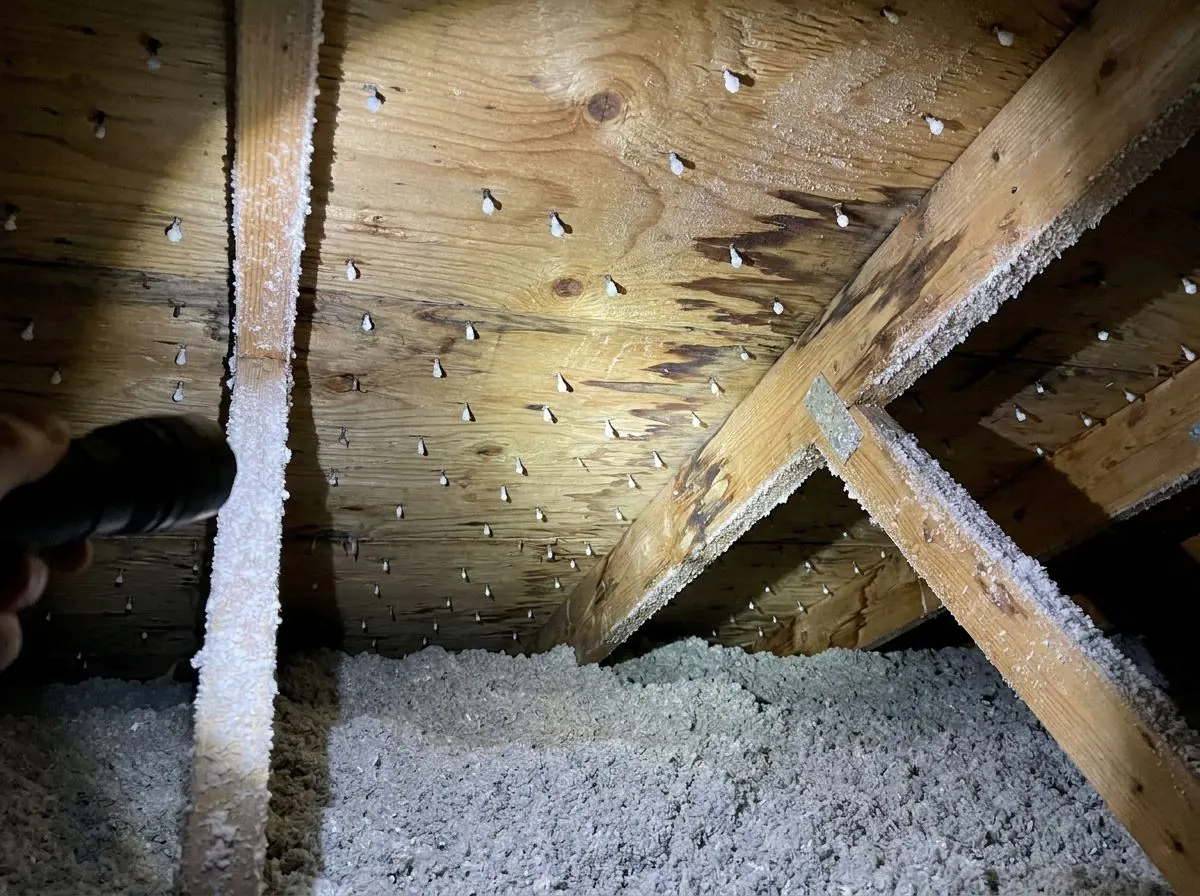
Attic frost is the same leak showing up in a different way. During a long cold snap, warm, moist house air escapes through gaps in the ceiling into the attic. That moisture freezes on the coldest surfaces it finds, the underside of the roof sheathing and the tips of the roofing nails, and builds up for days. Then a warm wind arrives, the attic temperature jumps, and the frost melts in a few hours. Water drips onto the insulation, through the ceiling drywall and out of light fixtures and bathroom fan grilles. People call it a raining attic, and it often gets mistaken for a roof leak.
Heat cables and new shingles treat what you can see. The causes underneath are usually the same few: holes in the ceiling where plumbing stacks, wires and pot lights pass through; a poorly sealed attic hatch; bathroom fans that dump humid air into the attic instead of outdoors; insulation that has settled or was thin to begin with; and soffit vents that are blocked by insulation or paint, so the attic cannot flush out the moisture it does receive.
How It Works
The order matters. Air sealing comes first, because insulation slows heat but does not stop air, and air carries both the heat that melts snow and the moisture that becomes frost. We pull back the existing insulation at the leak points and seal the top plates, wire and pipe penetrations, pot light housings, duct boots, the hatch and any chases. Flue and chimney openings get sheet metal and high-temperature sealant with the required clearance kept, never foam. Bathroom fans are checked and, where they vent into the attic, rerouted to the exterior.
Next the eaves are opened up. Baffles go in between the trusses or rafters so insulation can extend over the top plate without choking the soffit, and wind dams stop gusts from blowing through the edge of the insulation. We also confirm the soffit panels actually let air in. Only then is the attic topped up with blown cellulose or fibreglass toward about R-60, blown to the depth on the bag’s coverage chart and marked with attic rulers. The result is a colder roof deck, a drier attic and far less meltwater at the eaves.
How the Job Runs, Step by Step
Find the leaks and the wet spots
We look at the attic in person, ideally during cold weather, for frost patterns, stained sheathing, dark nail tips, rusted fasteners and compressed or wet insulation. An infrared scan from inside the house shows where warm air is escaping at the ceiling.
Fix the moisture sources
Bathroom and kitchen fans that end in the attic, disconnected duct, or a dryer vent in the wrong place are corrected first. Wet insulation is dried or removed. There is no point in sealing an attic while a fan is still blowing shower steam into it.
Air seal the attic floor
Insulation is moved aside at each target and the gaps are sealed: top plates, plumbing stacks, wiring holes, pot lights, duct boots and fan housings. The hatch gets weatherstripping and insulation on its lid. Flues and chimneys are sealed with sheet metal and high-temperature sealant only.
Prepare the soffits and eaves
Baffles are fastened in every bay at the eaves so a clear airway runs from the soffit into the attic, and wind dams close off the top of the exterior wall. Blocked or painted-over soffit vents are identified, and we tell you if the soffit itself needs work from outside.
Top up toward R-60 and document it
Cellulose or fibreglass is blown evenly across the attic to the coverage chart depth for the target R-value, with rulers set so the depth can be checked later. You get photos of the sealed penetrations, baffles and final depth.
What Decides the Specification
The biggest variable is what is already up there. A thin but dry layer of fibreglass or cellulose can usually stay and be topped up once the leaks under it are sealed. Insulation that is soaked, mouldy, rodent-damaged or so deep it makes air sealing impossible may need to come out first. The roof shape decides how well the eaves can be insulated; low-slope trusses leave very little height at the top plate, which makes baffles and wind dams even more important.
Cellulose and loose-fill fibreglass both work for the top-up. Cellulose is denser and resists wind-washing better at the eaves, which suits this area’s gusty exposures. Fibreglass is lighter on older ceiling drywall and does not absorb water. The target is guided by Section 9.36: about R-60 for a home without an HRV, about R-49 with one. An existing house is not required to meet those new-construction values, but they are the sensible benchmark.
Alberta Code Notes
Section 9.19 of the National Building Code – 2020 Alberta Edition generally calls for attic vent area of at least 1/300 of the insulated ceiling area, split between low and high vents, and insulation must not block the airflow from the soffits. Section 9.25 covers air leakage and condensation control, which is the part of the code that the air sealing work addresses. Section 9.36 sets the new-construction ceiling targets for climate zone 7A that we use as the top-up benchmark. Loose-fill products are made to CAN/ULC-S703 for cellulose and CAN/ULC-S702 for fibreglass, and installed depth comes from the manufacturer’s coverage chart. Grey-brown or gold pebble-like vermiculite may contain asbestos; we do not disturb it, and it must be tested and handled under Alberta OHS asbestos rules by a specialist before any attic work continues.
General guidance only. The authority having jurisdiction and the product’s own evaluation report decide what applies to your job.
Around Airdrie
Few places see attic frost melt the way this area does. Chinooks can lift the temperature by 20°C or more in a matter of hours, so an attic that has been collecting frost through a week at -30°C thaws almost all at once. Homes in Hillcrest and other older parts of Airdrie often combine settled insulation, unsealed ceiling penetrations and bathroom fans that were never ducted outside, which is the full recipe. Woodside homes built in the 1990s and 2000s commonly have attic insulation at older levels and pot lights added by owners over the years.
Wind is the other local factor. The prevailing west and northwest winds across open prairie, and the stronger foothills gusts out toward Cochrane, drive air through soffits and can scour loose insulation back from the top plate. That leaves a cold strip along the ceiling edge exactly where ice dams form, which is why wind dams are part of every job here, and why denser cellulose is often the better top-up on exposed lots.
Often Done Alongside
Attic Air Sealing & Penetration Proofing
Hand-sealing stacks, wiring holes, top plates, fixtures and flue chases.
Attic Venting & Baffle Prep
Rafter vents and wind dams that keep soffit-to-ridge airflow open.
Blown-In Cellulose Attic Top-Ups
Borate-treated cellulose blown over old attic insulation toward about R-60.
Where We Do This Work
Ice Dams & Frost: Questions We Get
Is some frost on the roofing nails normal during a deep cold snap?
Water dripped from my ceiling light during a chinook. Is my roof leaking?
Should I get my attic done before winter or wait until it is cold?
Do I need to remove my old attic insulation to fix ice dams?
Do I need a permit for insulation work?
Considering Ice Dams & Frost?
Call Airdrie Insulation or send the details. We will look at the job, tell you whether ice dams & frost is the right fix, and price it in writing.