Dense-Pack Wall Insulation Injection for Airdrie Homes
Dense-pack fills closed wall cavities with insulation blown through a tube at high pressure, from outside behind lifted siding or from inside through the drywall. It suits empty or half-filled exterior walls in older homes, and it only goes ahead once wiring, blocking and the exterior water barrier have been checked.
The Problem It Solves
Some walls are cold because there is almost nothing in them. Older homes, and some later additions and renovations that were never finished properly, can have exterior wall cavities that are empty, half full, or stuffed with batts that have slumped to the bottom of each bay. The result is a wall that feels cold to your hand in winter, rooms that are hard to keep comfortable next to outside walls, and furniture that has to be pulled away from them. A thermal camera usually shows the pattern in stripes.
The usual fix for an under-insulated wall is to gut it: pull the drywall, insulate, install new vapour barrier, board, tape and paint. That is the right approach when a room is being renovated anyway. It is a big, messy disruption when the only reason to open the wall is the insulation, especially in a finished home with trim, built-ins and plaster that owners would rather keep. Every opened wall also means days of a room out of service.
Loose insulation poured or lightly blown into a closed wall is not a good answer either. Loose fill in a vertical cavity settles, leaving an uninsulated gap at the top of every bay within a few years, and it does little to slow air moving through the cavity. Batts cannot be slid into a closed wall at all. The challenge is not getting insulation into a closed cavity, but packing it tightly enough that it stays full from bottom plate to top plate.
How It Works
Dense-pack works by blowing insulation through a narrow fill tube pushed up and down inside the stud bay, and packing it until the cavity will not take any more. At that density, commonly about 3.5 lb/ft³ for cellulose, the fibre locks into place and does not settle the way loose fill does. It also fills around wiring, pipes and irregular framing, and because the fibre is packed tight, it slows air moving through the cavity much more than batts with gaps around them.
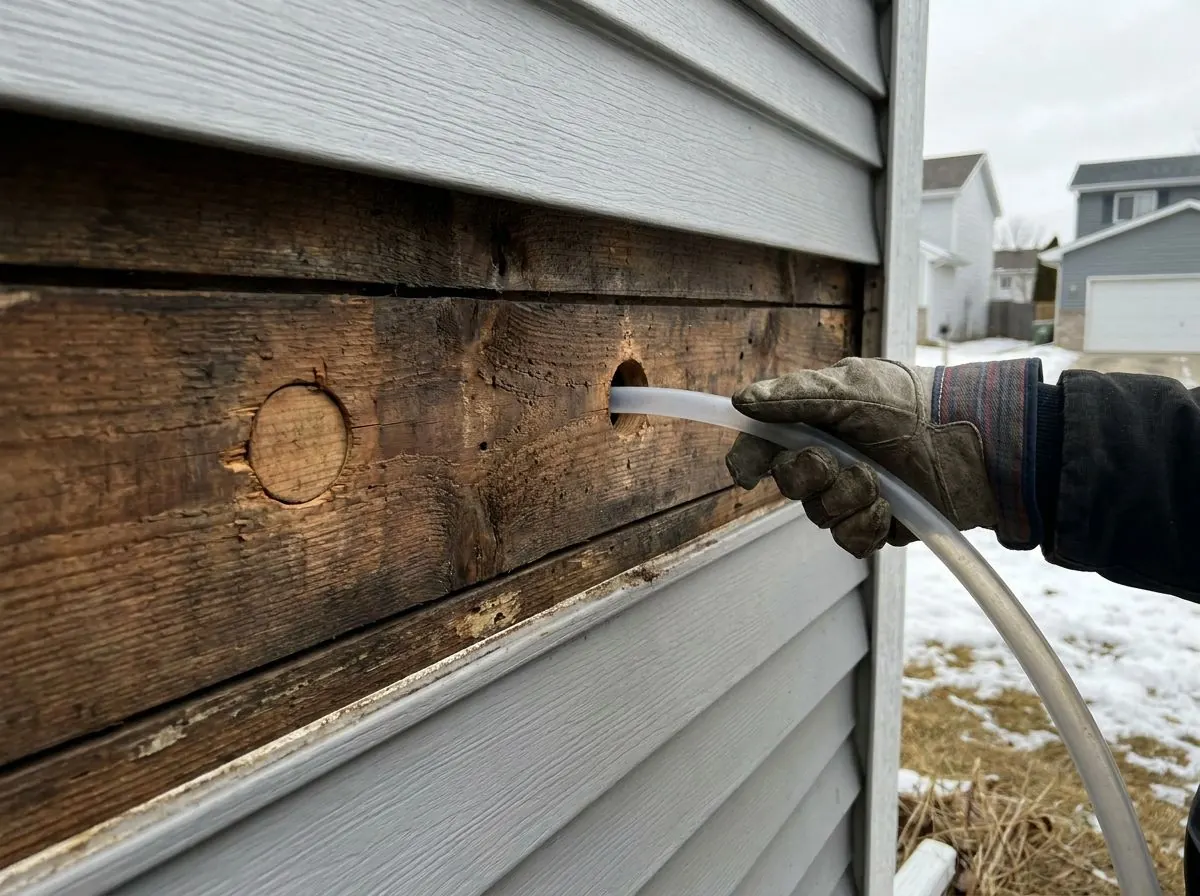
The work can be done from either side of the wall. From outside, a course or two of siding is removed, holes are drilled through the sheathing into each bay, the cavity is filled, the holes are plugged and sealed, and the siding goes back on. From inside, holes are drilled through the drywall or plaster, then plugged, patched and left ready for paint. Outside access keeps the mess out of the house; inside access suits cladding that cannot come off cleanly.
Every bay is its own cavity. Fire blocking, mid-height blocking, window headers and diagonal bracing all split the wall into sections, and a single hole cannot fill past them. Finding those obstructions, and drilling above and below them where needed, is the difference between a wall that is actually full and one that is full in patches. Short bays above headers and below sills are easy to miss, and each is treated as a separate fill.
How the Job Runs, Step by Step
Scanning walls and checking wiring
We look at the walls with a thermal camera where conditions allow, probe a few bays to see what is inside, and confirm the wiring. Knob-and-tube wiring still in service inside a cavity is a hard stop until an electrician has dealt with it. We also check the cladding and water-resistive layer for signs of leaks.
Mapping bays and blocking
Stud locations, windows, doors, outlets and blocking are marked on each wall so every bay has a drilling plan. Where blocking splits a bay, it gets a hole above and below. Outlets and switches on exterior walls are noted so fibre does not push out of boxes.
Opening the wall
For exterior access we remove siding courses carefully so they can be reinstalled, then drill through the sheathing. For interior access we drill neat holes in drywall or plaster at a consistent height, with the floor and furniture protected and dust controlled at each hole.
Tube filling to density
The fill tube is fed into the cavity and the bay is packed from the far end back toward the hole, with machine settings adjusted to the manufacturer’s instructions for dense-pack. Material use is tracked per wall section so an under-filled bay stands out rather than hiding.
Plugging, patching and verifying
Holes are plugged and sealed, sheathing penetrations are covered so the water-resistive layer is continuous, and siding is reinstalled. Interior holes are patched ready for paint. A follow-up thermal scan in cold weather is the best way to confirm there are no missed bays.
What Decides the Specification
The wall itself sets most of the specification. Cavity depth decides the R-value you can reach: a 2x4 wall has only so many inches to fill, so dense-pack improves an empty wall a great deal but will not match a new 2x6 wall with exterior insulation. Framing layout decides how many holes are needed. Existing contents matter too. Bays holding slumped batts can sometimes be dense-packed around them, but a bay full of settled loose fill may need to be opened differently or left alone.
Cladding and moisture decide whether the job should happen at all. Dense-packed walls have less heat moving through them, which makes the sheathing colder in winter and slower to dry. That is fine behind a sound cladding and water-resistive barrier with a working interior vapour barrier, and a problem behind siding that already leaks. Material choice follows from the wall: cellulose is the common dense-pack fill, while some fibreglass products are made for it where the owner prefers a mineral fibre.
Alberta Code Notes
There is no prescriptive requirement to bring an existing wall up to current standards. Section 9.36 of the National Building Code 2020 Alberta Edition sets effective wall values for new houses in zone 7A, which a filled 2x4 wall will not reach, so we never call the result code-level. Section 9.25 is still relevant because it deals with heat transfer, air leakage and condensation control. An existing wall with an intact warm-side vapour barrier behaves well when filled; one without it deserves a closer look before we add insulation.
Cellulose for dense-pack is made to CAN/ULC-S703, and mineral fibre products to CAN/ULC-S702. The standards cover the material; the manufacturer’s instructions set the installed density. If the work involves removing and replacing exterior cladding or opening interior finishes, whether a permit is needed is up to the authority having jurisdiction, which may be the City of Airdrie, Rocky View County, or the town or city where the house sits. We check with the right office rather than assume.
General guidance only. The authority having jurisdiction and the product’s own evaluation report decide what applies to your job.
Around Airdrie
Most of Airdrie was built from the 1990s onward with insulated walls, so dense-pack is not a common need across the newer communities, and we will say so. It is more likely in the oldest housing: some early homes around Old Town, older houses in Crossfield, and farmhouses on Rocky View County acreages, where walls may have little insulation or were partly filled during a past renovation. It also comes up in additions and converted spaces, such as an enclosed porch, closed up before anyone insulated them properly.
Often Done Alongside
Thermal Imaging & Draft Audits
Infrared scans to find leaks and gaps, with before-and-after images.
Blown-In Cellulose Attic Top-Ups
Borate-treated cellulose blown over old attic insulation toward about R-60.
Attic Air Sealing & Penetration Proofing
Hand-sealing stacks, wiring holes, top plates, fixtures and flue chases.
Where We Do This Work
Dense-Pack Walls: Questions We Get
How can you tell if my walls are empty before drilling holes?
Is it better to dense-pack from the outside or the inside?
Will dense-pack insulation settle inside the wall over time?
Does dense-pack in my walls replace the need for a vapour barrier?
How do I know the work was done properly?
Considering Dense-Pack Walls?
Call Airdrie Insulation or send the details. We will look at the job, tell you whether dense-pack walls is the right fix, and price it in writing.