HEPA Vacuum Attic Insulation Removal in Airdrie
When attic insulation is soiled by mice, soaked by a roof leak or matted with mould, topping it up only buries the problem. We extract it with a high-powered HEPA-filtered vacuum, clean the attic floor, and leave it ready for air sealing and new insulation.
The Problem It Solves
Most attic insulation lasts the life of the house if nothing gets into it. The trouble starts when something does. Deer mice and other rodents tunnel through loose-fill, nest against the warm ceiling drywall and leave droppings and urine through the whole layer. A roof leak or years of dripping attic frost can soak cellulose until it packs down into a dense crust with a fraction of its original R-value. Smoke damage leaves an odour the insulation holds for years. None of these problems improve by blowing a fresh layer over the top.
Contaminated insulation causes more than a thermal loss. Rodent waste in the attic is a health concern, because deer mice in Alberta can carry hantavirus, and dried droppings disturbed without precautions can put particles in the air. Wet cellulose can support mould growth and stain ceilings below. Compacted or crusted material leaves cold patches that show up as frost lines on the ceiling and higher heating bills. Homeowners often notice a smell at the hatch, scratching at night, or a stain spreading from a light fixture before they ever look in the attic.
The other common reason for removal is simply access. The attic floor is where the air leaks are: plumbing stacks, wiring holes through top plates, pot light housings and the gaps around interior wall tops. With 12 or 16 inches of old, dirty loose-fill in the way, nobody can find those leaks. When the existing layer is already compromised, taking it out is often the cleaner path to a sealed, warm ceiling.
How It Works
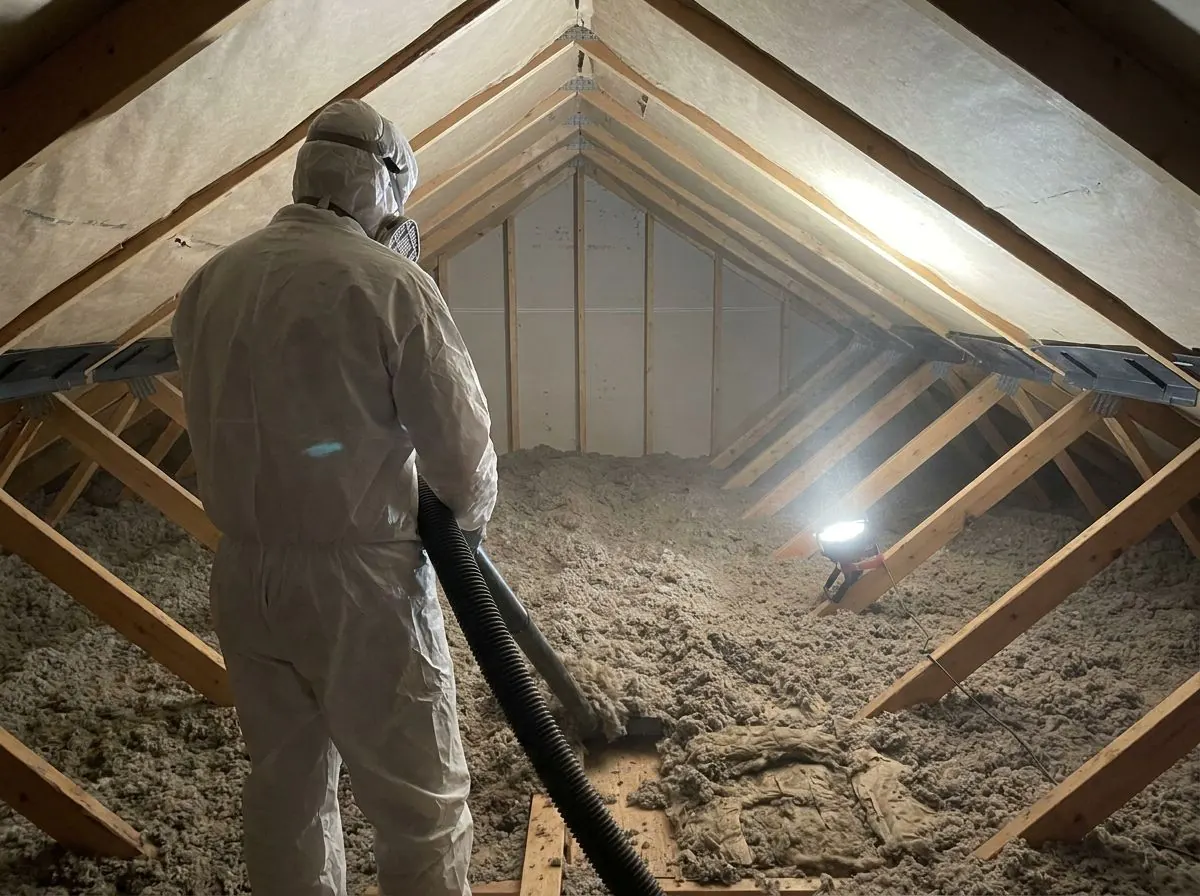
HEPA vacuum removal pulls the old insulation out of the attic through a large-diameter hose to a collection unit parked outside. The hose runs through the attic hatch or, where possible, an exterior access. The machine's exhaust passes through HEPA filtration, which captures fine particles before the air is released, so dust from the attic is not simply blown around the yard. Waste goes into heavy bags or a sealed container for disposal. Inside the house, the hatch area and the route to it are protected and sealed off so the rest of the home stays clean.
The vacuum does the heavy lifting, but the finish matters as much. Once the bulk is out, the crew works the attic floor by hand, clearing the corners at the eaves, the spaces between trusses and the tops of interior walls where debris collects. With the ceiling plane exposed, the damage becomes visible: stained sheathing, chewed wiring, rodent entry points, bathroom fans ducted into the attic. Those findings are photographed and discussed with you, because removal fixes nothing if the cause is still there. An empty attic is also the best chance the house will get for thorough air sealing before new insulation goes in.
How the Job Runs, Step by Step
Attic inspection and material check
We look at the insulation before quoting removal: what it is, how deep, how contaminated, and why. If we see vermiculite, or grey-brown or gold pebbles in the loose-fill, we stop and recommend lab testing before anyone disturbs it.
Set up containment and protection
The vacuum unit is parked outside and the hose route is planned to avoid finished rooms where possible. Floors and walls along the route are covered, the hatch opening is sealed with poly around the hose, and crews suit up in disposable coveralls and fitted respirators before entering the attic.
Wet-down and extraction
Where rodent contamination is present, droppings and nesting areas are dampened with a disinfectant solution first so dried waste does not become airborne. The insulation is then drawn out through the HEPA-filtered vacuum, working from the far end of the attic back toward the hatch, and bagged or contained for disposal.
Clean the attic floor and document
After the bulk is gone, remaining debris is cleared by hand and with a HEPA vacuum from the eaves, truss bays and wall tops. We photograph the exposed ceiling plane, rodent entry points, water staining, bath fan terminations and any wiring damage, and flag anything an electrician or roofer should see.
Seal, baffle and re-insulate
With the ceiling plane open, penetrations are air sealed, the hatch is weatherstripped, and baffles go in at the eaves. Once entry points and leaks are dealt with, new cellulose or fibreglass is blown to the depth the bag chart gives for the target R-value, with depth markers left in place.
What Decides the Specification
The first question is always what the old material is. Cellulose, fibreglass and rock wool loose-fill come out cleanly with an insulation vacuum. Batts are often pulled by hand and bagged, because a vacuum struggles with them. Vermiculite is a different matter entirely: it is not something we vacuum, because it may contain asbestos and falls under Alberta's occupational health and safety rules for asbestos work. The second question is contamination. Rodent-soiled material needs wet-down and full respiratory protection. Wet or mouldy material is slower to extract, and whatever soaked it must be diagnosed first.
The attic itself sets much of the job. Low-slope roofs with little headroom at the eaves, truss webbing that limits movement, the number of ceiling penetrations and the distance from the hatch to the driveway all affect how removal is set up. Not every job needs a full strip: if contamination is limited to one area, partial removal can be the sensible scope, and we will say when the rest is sound enough to keep.
Alberta Code Notes
Removal of existing insulation is a repair activity, and whether any permit is involved is decided by the authority having jurisdiction. The re-insulation that follows is where the National Building Code – 2020 Alberta Edition becomes useful as a benchmark. Its Section 9.36 prescriptive target for ceilings below attics in climate zone 7A is RSI 10.43, about R-60, for a house without a heat-recovery ventilator. That is a new-construction value, not a retrofit obligation, but it is the sensible benchmark once the attic is empty. Section 9.19 attic ventilation also matters: new insulation must not block the soffit airflow.
Health and safety rules drive the handling more than the building code does. Vermiculite that may contain asbestos is regulated under Alberta's occupational health and safety asbestos requirements, which is why we stop and send you to testing and qualified abatement rather than proceeding. For rodent contamination, public health guidance on hantavirus is clear that droppings should be wetted with disinfectant and never swept or vacuumed dry without proper filtration and protection. Our procedure follows that approach.
General guidance only. The authority having jurisdiction and the product’s own evaluation report decide what applies to your job.
Around Airdrie
Around Airdrie, removal calls tend to come from two directions. Older established areas such as Hillcrest have attics that have had decades for mice to move in, for old cellulose to settle and crust, and for bathroom fans to be left dumping moist air into the attic. Out in Rocky View County, acreage homes near fields and farmyards see far more rodent pressure than city lots, and deer mice nesting in attic loose-fill is a familiar story. Across the area, winter chinook swings can melt a cold snap's attic frost within hours, leaving cellulose matted near the worst leaks.
Often Done Alongside
Attic Air Sealing & Penetration Proofing
Hand-sealing stacks, wiring holes, top plates, fixtures and flue chases.
Blown-In Cellulose Attic Top-Ups
Borate-treated cellulose blown over old attic insulation toward about R-60.
Thermal Imaging & Draft Audits
Infrared scans to find leaks and gaps, with before-and-after images.
Where We Do This Work
Insulation Removal: Questions We Get
How do I know if my attic has vermiculite rather than regular loose-fill?
Is it safe to stay in the house during HEPA insulation removal?
Can you remove just the section of insulation that the mice got into?
What happens to the old insulation after it is removed?
Can you insulate in the middle of an Airdrie winter?
Considering Insulation Removal?
Call Airdrie Insulation or send the details. We will look at the job, tell you whether insulation removal is the right fix, and price it in writing.