ROCKWOOL Comfortbatt Mineral Wool Insulation in Airdrie
Stone wool thermal batts for exterior wood-frame walls and framed walls built inside concrete or masonry. Comfortbatt is water-repellent and noncombustible, cuts cleanly and holds its shape in the cavity. It still needs a sealed vapour barrier.
The Problem It Solves
When an exterior wall is opened for a renovation, the insulation inside often tells a story. Batts have slumped to the bottom of the bay, pulled away from the studs, or been cut short around a window. Whatever goes back into that wall will be closed up for decades, so it makes sense to use a batt that stays put and forgives some of the realities of an older house.
Some walls also carry more risk than others. A framed wall built inside a concrete foundation or a masonry wall sits against a surface that can be damp, cold and slow to dry. A wall beside a furnace room, a wood stove or an attached garage raises fire questions. A light, soft batt does the thermal job in all of those walls, but it does nothing extra for the other concerns.
People also misunderstand what mineral wool can do. It is often described as moisture-proof or as a material that lets you skip the vapour barrier because it breathes. Neither is right. Stone wool sheds water well and tolerates getting damp better than many materials, but it does not stop leaks, and warm moist air can pass through it to a cold surface just as easily as it passes through fibreglass.
How It Works
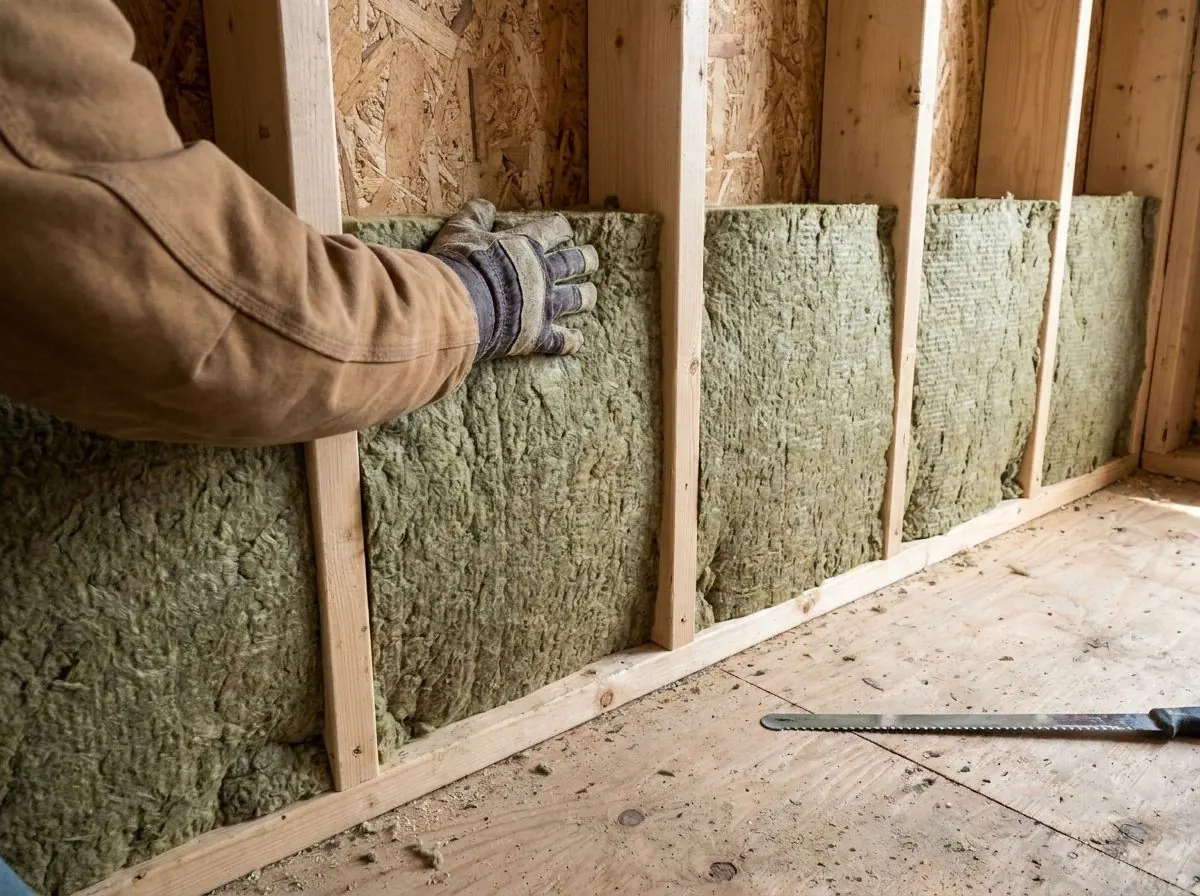
ROCKWOOL Comfortbatt is a stone wool batt made for exterior walls. It is denser and stiffer than typical fibreglass, so it friction-fits into the cavity and stays there without sagging over time. It cuts cleanly with a serrated knife, which makes tight fits around boxes, pipes and odd-width bays easier and more accurate. The fibres are water-repellent, so incidental moisture beads rather than being drawn in, and the material dries out rather than holding water against the framing.
Stone wool is also noncombustible, which is why it is often chosen for walls near heat sources and for assemblies where fire performance is part of the design. Its density gives some sound absorption as a side benefit, although a quieter wall still depends on sealing and drywall, not the batt alone. None of that changes the building science of a cold-climate wall: the batt goes in with a continuous, sealed 6-mil poly vapour barrier on the warm side, and air leaks at plates, boxes and windows get sealed just as carefully as with any other batt.
How the Job Runs, Step by Step
Assess the opened wall
In a renovation, we remove old insulation and look at what it was hiding: stained or soft sheathing, signs of past leaks around windows, wiring that should be checked by an electrician, and old vapour barrier that may need to come out. In framed walls inside concrete or masonry, we check for dampness, efflorescence or active leaks before insulating anything.
Measure the cavities
We measure depth and spacing rather than assuming modern framing. Older houses and walls strapped inside masonry often have odd stud widths, shallow cavities and irregular bays. Comfortbatt comes in sizes for common framing depths, and the product and size are chosen so the batt fills the cavity without being compressed.
Cut and fit each batt
Batts are cut with a serrated knife slightly wider than odd bays so they press against the framing. Around wiring, the batt is split or notched so it sits on both sides of the cable. Electrical boxes, vent stacks and supply lines get a close, shaped cut. The stiffness of stone wool keeps those cuts crisp, so there is less guesswork at the edges.
Detail windows, corners and heat sources
Headers, corners and the narrow spaces beside windows get hand-cut pieces. Gaps around window and door frames are sealed first with low-expansion foam or backer and sealant. Near chimneys and appliances, stone wool helps, but required clearances for flues and heat-producing equipment are set by their listings and code, and we keep them.
Seal the vapour barrier over it
The finished wall gets continuous 6-mil poly with acoustical sealant at the top and bottom plates and at laps over framing, plus sealed hats or airtight boxes at electrical outlets. Where the work is part of a permitted renovation or basement development, the insulation and vapour barrier are left ready for the inspector to see before drywall.
What Decides the Specification
Framing depth sets the size, and the reason for choosing stone wool sets whether it is the right product at all. If the goal is simply thermal resistance at the lowest cost, a well-installed fibreglass batt does the same thermal job at the same labelled R-value. Comfortbatt earns its place when fire performance, water tolerance, easier accurate cutting or some added sound absorption matter to the wall in question.
The wall behind the batt is the other driver. Framed walls inside concrete foundations, and interior-insulated masonry walls in older buildings, can trap moisture if warm indoor air reaches the cold masonry or if the masonry was relying on indoor heat to dry. Those walls deserve a moisture plan before any insulation goes in, and sometimes closed-cell foam against the concrete, with batts in the framed wall inside it, is the better assembly.
Alberta Code Notes
Under the National Building Code – 2020 Alberta Edition, Section 9.25 governs insulation, air barrier systems and vapour barriers in houses. A vapour-permeable batt such as Comfortbatt does not change the need for a vapour barrier on the warm side, which in most houses is 0.15 mm (6-mil) polyethylene to CAN/CGSB-51.34, sealed at laps, plates and penetrations. Section 9.36 sets energy requirements for new work in climate zone 7A as effective values for the whole wall, so the label on the batt is only part of that calculation.
Noncombustible insulation can be part of a fire-rated assembly, but the rating belongs to the listed assembly as a whole, including board type and fastening. Whether a renovation needs a permit is decided by the authority having jurisdiction. In Airdrie that is the City of Airdrie, in Crossfield the Town of Crossfield, and outside town limits it is often Rocky View County. If the wall is part of a basement development, the insulation and vapour barrier fall under that development’s permit.
General guidance only. The authority having jurisdiction and the product’s own evaluation report decide what applies to your job.
Around Airdrie
Hillcrest is among Airdrie’s older established neighbourhoods, with a lot of housing from the 1970s through the 1990s. Renovations there often open exterior walls to replace windows, update wiring or rework a kitchen, and the insulation behind the drywall is frequently thin, settled or pulled away from the framing. Replacing it with a batt that holds its shape is a sensible upgrade while the wall is open, alongside a properly sealed vapour barrier.
Crossfield’s older small-town homes and shops raise similar questions, sometimes with foundation or masonry walls that have seen decades of freeze-thaw. Across the area, long cold spells and quick chinook warm-ups mean walls go through repeated wetting and drying at their cold surfaces. A water-repellent batt that tolerates that cycle is a reasonable choice, provided the air and vapour control in front of it is done right and sealed at every plate and box.
Often Done Alongside
Fibreglass Thermal Batts
R-14 to R-28 friction-fit batts, cut tight for exterior stud walls.
ROCKWOOL Safe’n’Sound Acoustic Batts
Safe’n’Sound batts for quieter interior walls, ceilings and floors.
Exterior Continuous Insulation (CI)
Rigid mineral wool and XPS boards outside the framing, behind rainscreen cladding.
Where We Do This Work
Comfortbatt: Questions We Get
Is Comfortbatt warmer than fibreglass at the same R-value?
Does ROCKWOOL Comfortbatt need a vapour barrier in Alberta?
Can Comfortbatt go against a concrete foundation wall?
Why choose mineral wool if fibreglass has the same rating?
How do I know the work was done properly?
Considering Comfortbatt?
Call Airdrie Insulation or send the details. We will look at the job, tell you whether comfortbatt is the right fix, and price it in writing.