Ductwork, HVAC Wrap and Mechanical Insulation in Airdrie
Cold ducts drip and warm ducts in cold spaces waste heat. We install FSK-faced duct wrap, pipe insulation and vapour-retarding jackets on HRV lines, supply runs through unheated space and commercial mechanical systems in Airdrie and area, following the mechanical engineer’s specification.
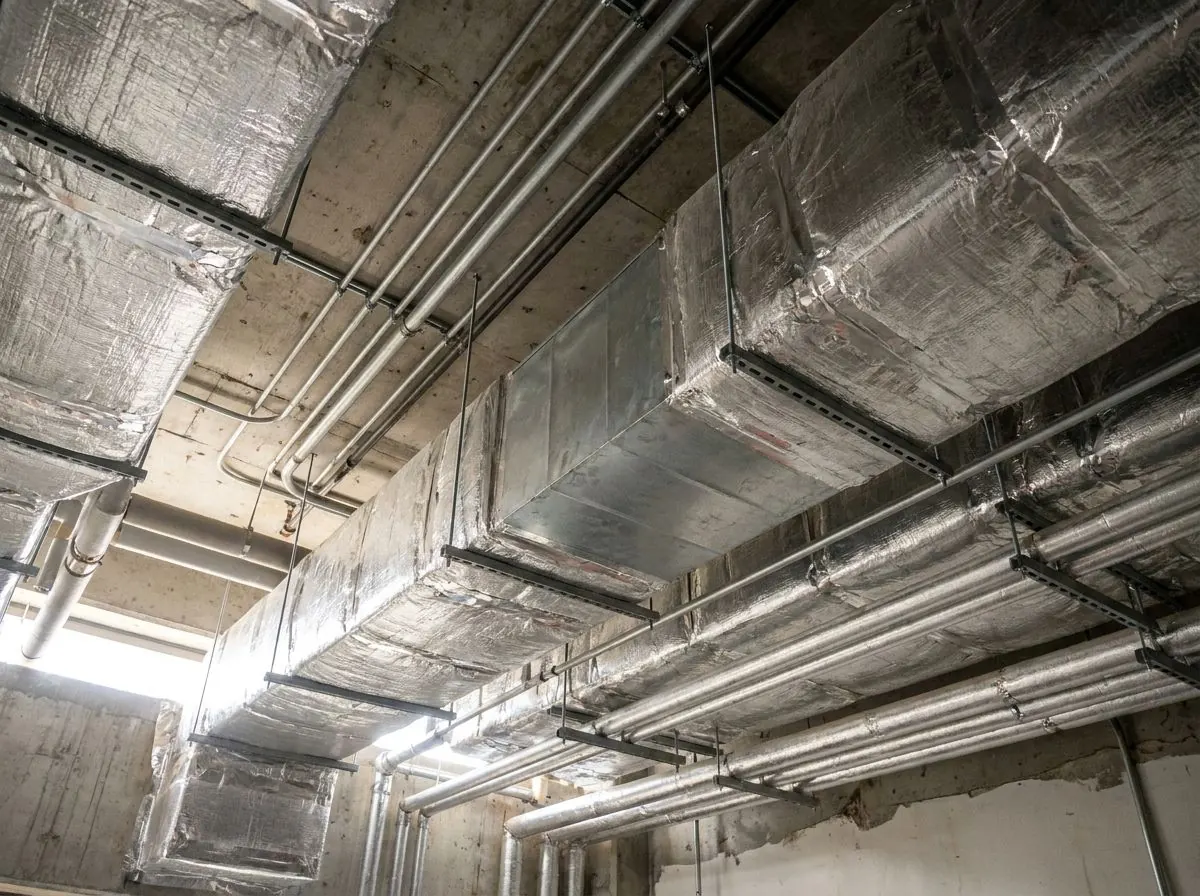
The Problem It Solves
A duct carrying air colder than the room around it behaves like a cold drink on a summer day. In a house, the worst offenders are the two ducts that run from the heat-recovery ventilator to the outside wall: the fresh-air intake and the exhaust. In an Airdrie winter the intake carries outdoor air at minus 20°C or colder through a warm basement. If its insulation jacket is torn, loose at a joint or missing at the connection, warm basement air reaches the cold metal or flex liner, condenses and freezes. When the weather breaks, that ice melts and water runs out of the duct onto ceiling drywall and flooring.
The opposite problem wastes energy. Supply ducts that pass through an unheated garage ceiling, a crawl space, an attic or a cantilevered floor lose heat before the air reaches the room. The bonus room at the end of that run stays cold no matter how long the furnace runs. In commercial buildings the same losses show up on rooftop units, make-up air ducts and piping that runs through unheated mechanical rooms, loading areas or ceiling spaces above the insulation.
Noise is the third complaint. Bare sheet metal carries fan and air-rush noise from the equipment to every diffuser. In offices, clinics and multi-unit buildings, a supply trunk shared between rooms carries conversations from one space into the next. People often try to solve this by adding insulation to walls when the path is actually running through the ductwork above the ceiling.
How It Works
On cold ducts and pipes, the insulation has to do two things: slow heat gain and keep humid air away from the cold surface. That is why the facing matters as much as the fibreglass. FSK duct wrap has a foil-scrim-kraft skin that acts as a vapour retarder, but only if every seam, joint, hanger and connection is taped so the skin is unbroken. A single open seam lets moist air reach the metal and the drip starts again, just in a less visible place.
On warm ducts through cold space, the goal is simply R-value and airtightness. Duct joints are sealed first, because wrapping a leaky duct only hides the leak, and wrap is then installed without crushing it at hangers and corners. Acoustic problems are handled with internal liner, lined sections or duct silencers placed by the mechanical designer, since liner is normally installed at fabrication, while external wrap mainly deals with heat and condensation rather than noise inside the duct.
How the Job Runs, Step by Step
Trace the duct and find the wet spot
We follow the run from the equipment to the wall or roof, looking for water staining, rust streaks, torn jackets and gaps at connections. On HRV lines the connection at the unit and the wall hood are checked first, since that is where jackets most often pull loose. On commercial work we start from the mechanical drawings and the insulation schedule.
Seal the duct before wrapping
Duct joints and seams are sealed with mastic or approved tape as the mechanical specification allows. Loose hangers are corrected so the wrap will not be crushed. Any water already inside a duct is traced to its source, because a sweating intake can also be a sign of a failed wall hood letting in snow.
Cut and fit the wrap
Blanket is cut to go around the full duct perimeter with an overlap, stapled at the overlap where the specification permits, and the staples and seams covered with foil tape. Compression at corners is kept to what the manufacturer allows so the installed R-value holds.
Close every joint in the jacket
On cold lines, hangers, dampers, access doors and the ends of each run are detailed so the vapour-retarding jacket has no breaks. Fire dampers and their access panels stay operable and visible; insulation is kept clear of anything that must move or be inspected.
Label, photograph and report
We record what was insulated, the product used and where the jacket was tied into equipment and walls. On commercial projects that record goes to the general contractor or mechanical contractor for the closeout package, and any penetrations through fire separations are flagged for firestopping.
What Decides the Specification
Service temperature drives the product. Ducts carrying outdoor air, cooling-season supply air or chilled water need a continuous vapour-retarding jacket; heating ducts through cold space mainly need R-value. The surrounding air matters too: a humid pool room, kitchen or wash bay pushes more moisture at a cold duct and needs thicker insulation and a tougher jacket. Where ducts are exposed in occupied space or in a plenum, the materials must carry flame-spread and smoke-developed ratings that suit that location.
On commercial and institutional buildings, the mechanical engineer’s specification sets product, thickness, jacket and which systems get insulated, and the NECB 2020 sets minimum insulation for ducts and piping in the buildings it covers. We install to that specification rather than substituting. On houses, the HVAC contractor’s design and Section 9.36 cover ducts outside the heated envelope, and HRV manufacturers state the insulated duct they expect on the cold side.
Alberta Code Notes
The National Building Code – 2020 Alberta Edition covers ducts in houses through Part 9, including energy requirements for ducts outside the conditioned space in Section 9.36. Larger buildings follow Part 3 and the NECB 2020, which set insulation requirements for mechanical systems. Where ductwork passes through a fire separation, the penetration is firestopped to a listed system and fire dampers are installed where required by the design; wrap must not interfere with a damper or its access. Commercial duct insulation may be reviewed as part of the mechanical permit and inspection, and the authority having jurisdiction decides what is reviewed.
General guidance only. The authority having jurisdiction and the product’s own evaluation report decide what applies to your job.
Around Airdrie
In Airdrie homes built through the 2000s and 2010s, including many in Coopers Crossing and Kings Heights, HRVs and bonus rooms over garages are common, and so are the two complaints that follow: water dripping from an HRV intake duct after a cold snap, and supply ducts losing heat in garage ceilings on the way to the bonus room. On the commercial side, the mixed office, warehouse and service buildings around Balzac and in north Calgary business parks carry make-up air units, rooftop units and long duct runs through unheated spaces where wrap failures show up as rust and ceiling stains.
Often Done Alongside
Commercial Firestopping
Listed firestop systems at pipe, cable, duct and joint penetrations in rated assemblies.
Attic Air Sealing & Penetration Proofing
Hand-sealing stacks, wiring holes, top plates, fixtures and flue chases.
Commercial Bay & Warehouse Spray Foam
Closed-cell foam sprayed direct to steel decks and panels to stop condensation drip.
Where We Do This Work
Duct Insulation: Questions We Get
Why is water dripping from the duct next to my HRV?
Does duct wrap reduce furnace or fan noise?
Can you insulate ductwork to a commercial mechanical specification?
Should ducts in a heated basement be insulated?
Do I need a permit for insulation work?
Considering Duct Insulation?
Call Airdrie Insulation or send the details. We will look at the job, tell you whether duct insulation is the right fix, and price it in writing.