Direct-to-Steel Spray Foam for Warehouses and Commercial Bays in Airdrie & Balzac
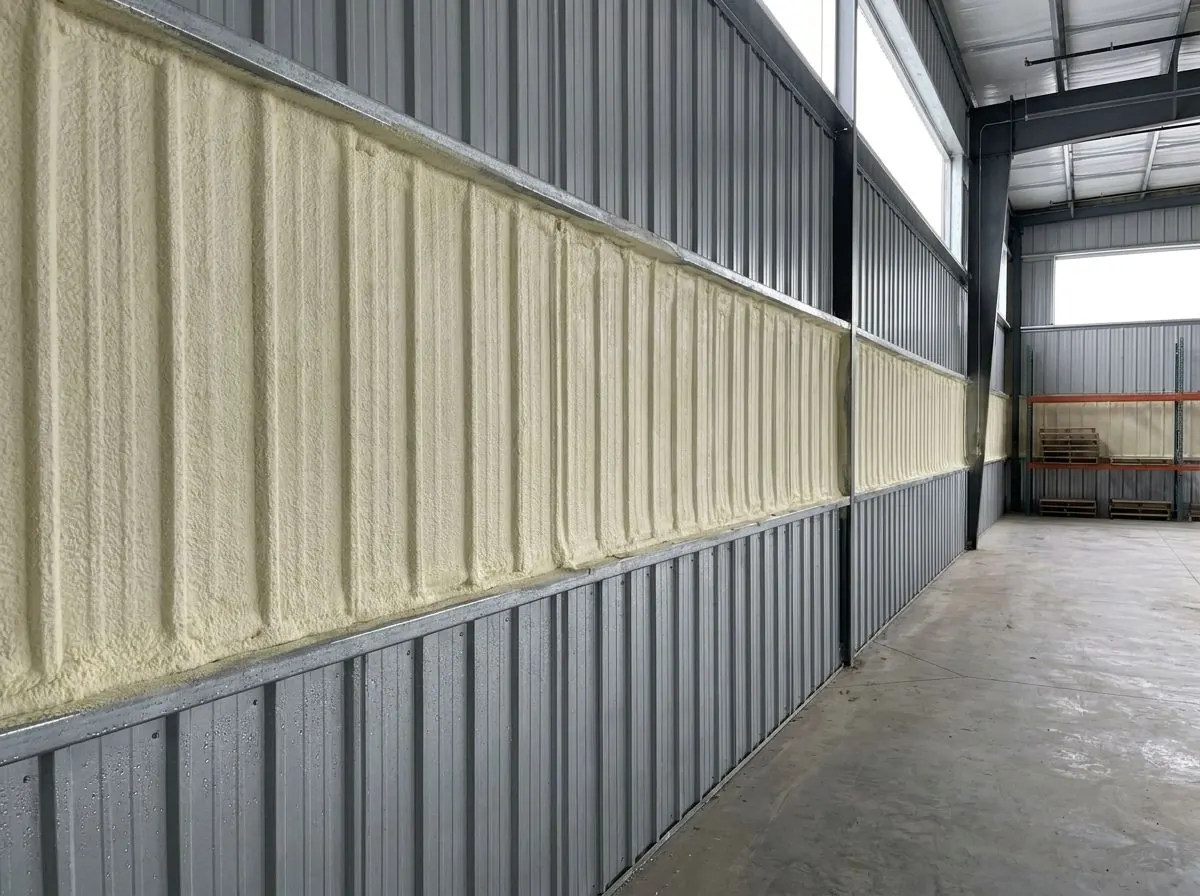
Warm, moist air meeting cold steel is why warehouse roofs rain on inventory and service bays drip on vehicles. We spray closed-cell foam straight onto corrugated roof decks and wall panels, seal the laps and fasteners, and protect it as the listing and Part 3 require, for owners, managers and GCs.
The Problem It Solves
A single-skin steel building has almost no resistance to heat flow. On a cold night the roof deck drops close to the outdoor temperature, and every source of moisture inside the building finds it. Trucks come in carrying snow, people breathe, wash bays steam, concrete gives off moisture for months after a pour, and direct-fired heaters that exhaust into the space add water vapour with every hour they run. When that air touches steel below its dew point, water forms on the underside of the deck and falls as a steady drip.
The damage is practical and expensive. Water spots stored goods and cardboard packaging, freezes into slick patches on the slab, drips onto parked equipment and runs down racking. Frost builds on the deck during a cold snap and lets go all at once when a chinook swings the temperature, so a manager walks in to what looks like a roof leak on a dry day. Over years, the constant wetting rusts fasteners, stains panels and breaks down the old vinyl-faced fibreglass blanket that many metal buildings were built with.
That original blanket is often part of the problem. Its facing tears, the seams separate, and warm air gets behind it to condense on the steel where nobody can see it. The fibreglass sags between purlins, holds water and becomes a nesting place for birds and mice. Replacing it with more of the same puts the next owner back in the same position within a few winters.
How It Works
Closed-cell foam sprayed directly onto clean steel bonds to the metal and leaves no air space behind it for moist air to reach. It fills the corrugations, wraps the fastener tips and seals the panel laps, so the building’s leakiest joints become part of a continuous air barrier. With the steel buried in foam, the surface that interior air touches is now the warm face of the foam rather than the cold deck. At the thicknesses commonly used in these buildings, closed-cell also resists vapour flow, which keeps moisture from working back to the steel.
The foam adds rigidity to panels, quiets rain and hail noise on the roof, and does not absorb water if a leak does develop. Because it holds its R-value per inch well, a heated bay reaches useful insulation levels without framing out a ceiling. The exposed foam then gets the protection the code and the product listing require, which in a commercial occupancy may be a thermal barrier such as gypsum board or, where the listing accepts it, an intumescent coating applied at a measured thickness.
How the Job Runs, Step by Step
Assess the steel and the roof
We look at the deck and panels from a lift before quoting: rust, mill oil, peeling faced blanket, and signs of genuine roof leaks. Foam hides the underside of the roof, so any leaking fastener, flashing or skylight curb has to be repaired by the roofer first. We also confirm the building’s use and whether the designer has set a protection requirement.
Remove old blanket and prepare surfaces
Failed vinyl-faced insulation is stripped and bagged. Steel is cleaned of dust, oil and loose rust and primed where the foam manufacturer requires it on galvanized or pre-finished panels. In winter the space is heated so the steel and air are within the manufacturer’s temperature range and the surface is free of frost.
Mask the operation around the work
Racking, stock, equipment, doors, lights and sprinkler heads are covered with poly and tape. Sprinkler heads and fire alarm devices are never sprayed. We plan zones with the manager so parts of the building keep working while one section is closed, and we watch the wind so overspray does not drift onto vehicles outside.
Spray in controlled passes
Foam goes on in lifts no thicker than the manufacturer’s maximum per pass so the heat of reaction stays controlled. Thickness is checked with a probe across the deck, and the CAN/ULC-S705.2 daily field tests and site records are completed. Purlins and girts are wrapped where the design calls for it to limit thermal bridging.
Protect, ventilate and hand over
The space is ventilated during spraying and the re-occupancy period set by the manufacturer, commonly about a day. The specified thermal barrier or listed coating is then installed, with coating wet-film thickness recorded. Masking comes down and the owner receives the thickness readings, product documentation and field-test records.
What Decides the Specification
Thickness is set by the job. A cold-storage building that only needs to stop drip can work with less foam than a heated shop that must also meet an energy target, but the foam still has to be thick enough that its inner surface stays above the dew point of the air inside. Buildings with high humidity, such as wash bays, need more. Where the energy code applies to an addition or a change of use, the designer’s energy compliance path sets the minimum R-value for the roof and walls.
Protection is the other deciding factor, and it often costs as much planning as the foam. The building’s classification, whether it is sprinklered, and the evaluation report for the specific foam determine whether gypsum board, a listed intumescent coating or another accepted barrier is required. Coatings are only accepted with particular foam products at particular foam and coating thicknesses, so the foam and coating are selected together rather than one at a time.
Alberta Code Notes
Larger warehouses and industrial buildings are designed under Part 3 of the National Building Code – 2020 Alberta Edition, with energy requirements from the NECB 2020 where they apply; a small steel shop may instead fall under Part 9. Part 3 restricts exposed foam plastic insulation, and the protection it needs depends on the occupancy and construction of the building. The foam’s evaluation report and any coating listing state what combinations have been tested and accepted. The authority having jurisdiction, commonly Rocky View County around Balzac or the City of Airdrie inside city limits, accepts the final approach.
The foam is installed to CAN/ULC-S705.2, which covers installer certification, daily field tests and the site records an owner or inspector can ask to see. Keep those records with the building file, because an insurer or future buyer may want them.
General guidance only. The authority having jurisdiction and the product’s own evaluation report decide what applies to your job.
Around Airdrie
The warehouse and distribution district around Balzac and the CrossIron Mills area holds a large stock of big-box logistics buildings, and alongside them are smaller steel-clad shops, contractor yards, flex bays and service garages where condensation problems are most common. Airdrie’s east industrial areas have the same mix of owner-operated metal buildings. Chinooks make it worse here than in steadier climates: frost that builds on steel decks during a cold week can melt in a single warm afternoon, and that is when most managers first call about a roof that seems to be leaking on a sunny day.
Often Done Alongside
Intumescent Thermal Barrier Coating
Paint-applied intumescent barrier over exposed foam, matched to that foam's listing.
Pole Barns & Agricultural Shops
Closed-cell foam for post-frame barns and ag shops to stop steel sweating and drip.
2lb Closed-Cell Spray Foam
2 lb foam: insulation, air barrier and vapour control for concrete and rim joists.
Where We Do This Work
Warehouse Foam: Questions We Get
Can you spray a warehouse while it is still operating?
Will spray foam on the roof deck stop the dripping completely?
Does the old faced fibreglass blanket have to come out?
What protects exposed spray foam in a commercial building?
How do you work out what my home actually needs?
Considering Warehouse Foam?
Call Airdrie Insulation or send the details. We will look at the job, tell you whether warehouse foam is the right fix, and price it in writing.