Intumescent Thermal Barrier Coating Over Spray Foam in Airdrie
Spray foam left exposed in a shop, garage, crawl space or warehouse still needs protection from fire. An intumescent coating such as DC315 is a paint-applied thermal or ignition barrier that swells into an insulating char when heated, accepted only with specific foams at specific thicknesses.
The Problem It Solves
Spray foam insulation is a combustible plastic. Left bare inside a building, it can ignite, spread flame across a ceiling or wall quickly and produce dense smoke. That is why the building code requires foam plastic to be separated from the interior by a thermal barrier. In a finished basement or bonus room, drywall does that job without anyone thinking about it. The difficulty comes where drywall is impractical: the underside of a steel roof, the curved walls of a quonset, the exposed purlins of a post-frame shop or the cramped walls of a crawl space.
Those are also the places owners most want foam, to stop condensation dripping from steel and to keep the wind out. Covering it with drywall means framing, fastening board to steel or awkward structure, taping, and then living with damage from equipment and moisture. So a lot of foam simply gets left bare. That leaves the fire exposure in place, can cause trouble with an insurer, and is the kind of thing an inspector or a buyer's home inspector will flag when the property changes hands.
The other common mistake is treating any fire-retardant paint as equivalent. A coating only counts as a thermal or ignition barrier over foam when it has been tested and accepted with that particular foam, at a particular foam thickness and a particular coating thickness. Paint rolled on too thin, over the wrong foam or over dusty foam may look finished and still not provide the protection the listing is based on, and nobody can tell by looking at it.
How It Works
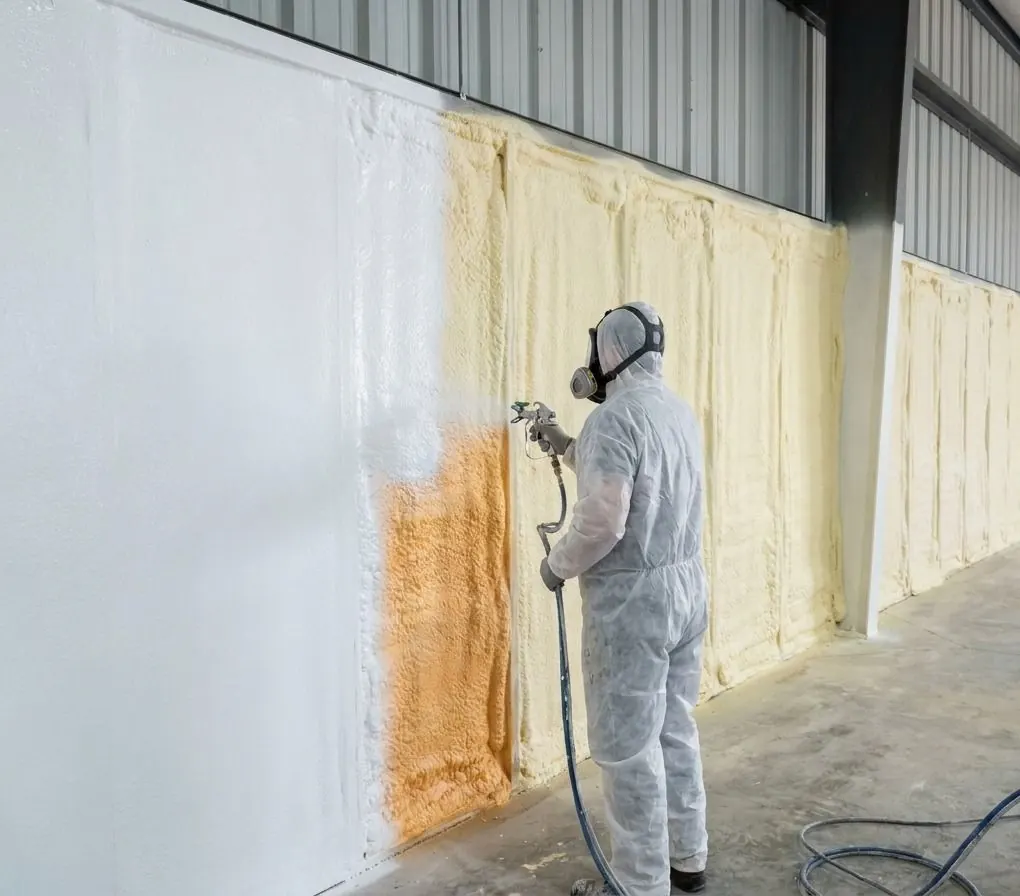
An intumescent coating is a water-based, paint-like product sprayed or rolled onto the foam. Under normal conditions it is a tough, paintable film. When heated by a fire, it swells into a thick, insulating char that shields the foam underneath, slowing ignition and flame spread and buying time for people to get out and for firefighters to respond. DC315 is one widely used example. The protection has limits: it slows the effect of fire on the foam for a tested period, it does not guarantee that nothing will burn, and it does not make foam non-combustible.
Acceptance depends on the tested combination. Each foam's evaluation report, or the coating's listing, names the coatings accepted as a thermal barrier or ignition barrier with that foam, the maximum foam thickness covered, and the coating thickness required, usually given as a wet-film thickness during application. We match the coating to the foam that is actually on the building, apply it at or above the listed wet-film thickness and check it with a wet mil gauge across the surface as we go. Done that way, it gives the inspector a documented alternative to drywall.
How the Job Runs, Step by Step
Identify the foam and its listing
We confirm which foam product is installed and how thick it is, from the installation records or by checking on site, then find the coating and thickness its evaluation accepts. If existing foam cannot be identified, that becomes a question for the inspector before any coating is applied.
Prepare the foam surface
The foam must be fully cured, clean, dry and free of dust, oil and loose overspray. Foam in shops and barns is often dusty or carries exhaust residue, so it is cleaned first. Voids and damaged areas are repaired, and anything not being coated is masked off.
Bring the building into range
Water-based coatings have minimum and maximum temperatures and humidity for application and drying. In an unheated building during an Airdrie winter, that usually means temporary heat and ventilation before, during and after the work, or scheduling the job for warmer weather.
Apply to the listed wet-film thickness
The coating is applied, usually with an airless sprayer, in one or more coats to reach the required thickness. Wet mil gauge readings are taken throughout, with extra attention at purlins, fasteners, corners and heavily textured foam, where the film tends to run thin.
Document it for the inspector and insurer
We record the foam product and thickness, the coating product, the area covered, gauge readings and site conditions, and leave the product data for your file. Inspectors and insurers commonly ask for that evidence, and it keeps the building's records straight for a future sale.
What Decides the Specification
The foam comes first. Coating type, coverage and wet-film thickness all come from the foam's evaluation report or the coating's listing for that foam, including the maximum foam thickness the test covered; foam sprayed thicker than that may fall outside the accepted combination altogether. The second driver is whether the location needs a thermal barrier or only an ignition barrier. Spaces people occupy, such as shops and garages, generally need a thermal barrier, while some attic and crawl space situations are treated differently, and the listing often gives a different coating thickness for each case.
Building type and use matter as well. Houses fall under Part 9 of the code, while warehouses, commercial bays and many larger shops fall under Part 3, where foam plastics face additional rules and tested assemblies. Moisture, abrasion and cleaning affect the choice too: livestock barns, wash bays and areas with vehicle or forklift traffic may need a topcoat compatible with the intumescent layer, or physical protection within reach, as the manufacturer permits. And wherever drywall is easy to install, it is often the cheaper and more durable barrier, so we price both.
Alberta Code Notes
Article 9.10.17.10 of the National Building Code - 2020 Alberta Edition requires foamed plastic insulation in houses to be protected from the interior by a thermal barrier such as 12.7 mm gypsum board, or by an alternative material or coating tested and accepted for use with that foam. Some attic, crawl space and rim joist situations are treated differently, with the foam's evaluation report, the coating's listing and the inspector deciding what applies. The foam itself is installed under CAN/ULC-S705.2 or CAN/ULC-S712.2, and its evaluation report is the document that names the accepted coatings.
Buildings under Part 3 bring additional requirements for foam plastics, and a thermal barrier coating over foam is not the same thing as a fire-resistance rating for a wall, a floor or structural steel; those are separate tested systems. Farm buildings are treated differently under the Safety Codes Act, so the county and your insurer should both confirm in advance what they expect. No coating turns foam into a non-combustible material.
General guidance only. The authority having jurisdiction and the product’s own evaluation report decide what applies to your job.
Around Airdrie
Around Balzac, warehouse and commercial bays with foam sprayed to steel roof decks and wall panels are the classic setting for a coating, because hanging drywall from high steel is impractical. Across Rocky View County, post-frame shops, pole barns and acreage garages are often insulated with closed-cell foam to stop roof steel sweating in winter, and many have been left bare. Chinook swings make uninsulated steel drip again and again as temperatures jump, which is why owners foamed those buildings in the first place, and a coating finishes the job the foam started. Crawl spaces in older homes are another place where a coating accepted for that location can beat framing and board.
Often Done Alongside
2lb Closed-Cell Spray Foam
2 lb foam: insulation, air barrier and vapour control for concrete and rim joists.
Commercial Bay & Warehouse Spray Foam
Closed-cell foam sprayed direct to steel decks and panels to stop condensation drip.
Commercial Firestopping
Listed firestop systems at pipe, cable, duct and joint penetrations in rated assemblies.
Where We Do This Work
Thermal Barrier: Questions We Get
What is the difference between a thermal barrier and an ignition barrier?
Can an intumescent coating like DC315 be painted over later?
Can existing spray foam be coated years after it was installed?
How long does an intumescent coating take to apply and dry?
How do you work out what my home actually needs?
Considering Thermal Barrier?
Call Airdrie Insulation or send the details. We will look at the job, tell you whether thermal barrier is the right fix, and price it in writing.