Pole Barn and Agricultural Shop Spray Foam for Airdrie & Rocky View County
Steel-clad pole barns sweat. Moist air from dirt floors, animals and heaters condenses under cold roof steel and drips on machinery and hay. We spray closed-cell foam direct to the steel on acreage shops and farm buildings around Airdrie and Rocky View County, and plan the coating and ventilation with it.
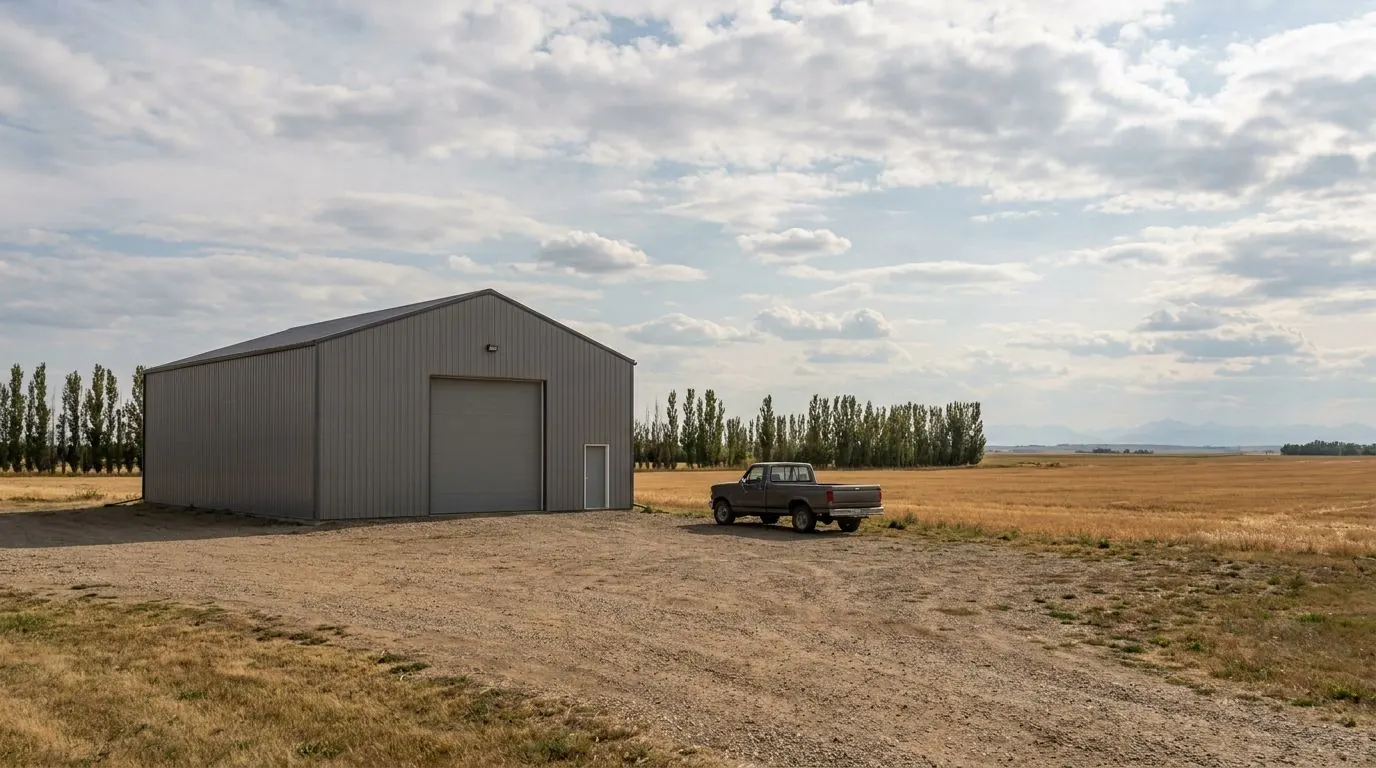
The Problem It Solves
A post-frame building is a steel skin hung on wood posts, purlins and girts. It goes up fast and costs less per square foot than almost anything else, but it has no thermal break at all. On a clear night the roof steel radiates heat to the sky and drops below the outdoor air temperature. Any moisture inside the barn, and there is a lot of it, condenses on that steel and drips. Farmers call it sweating, and on a bad morning it looks like rain inside a building with a sound roof.
The moisture comes from sources a house never has. Many pole barns have gravel or dirt floors that give off ground moisture all winter. Equipment comes in packed with snow. Livestock and horses breathe out a surprising amount of water and add ammonia from manure, which is hard on bare steel and fasteners. A heated ag shop run on weekends swings from cold to warm and back, so the steel sweats every time the heater kicks on. The drip rusts screws, spots paint on tractors and trucks, and soaks stored hay and feed.
Traditional fixes do not last well in farm conditions. Batts stapled between girts with poly over them get torn by equipment and pulled apart by mice nesting in the fibreglass. Barn swallows and sparrows build in the gaps at the eaves. Once the poly tears, moist air gets behind the batts to the steel, and now the condensation is hidden and soaking the insulation instead of dripping where you can see it.
How It Works
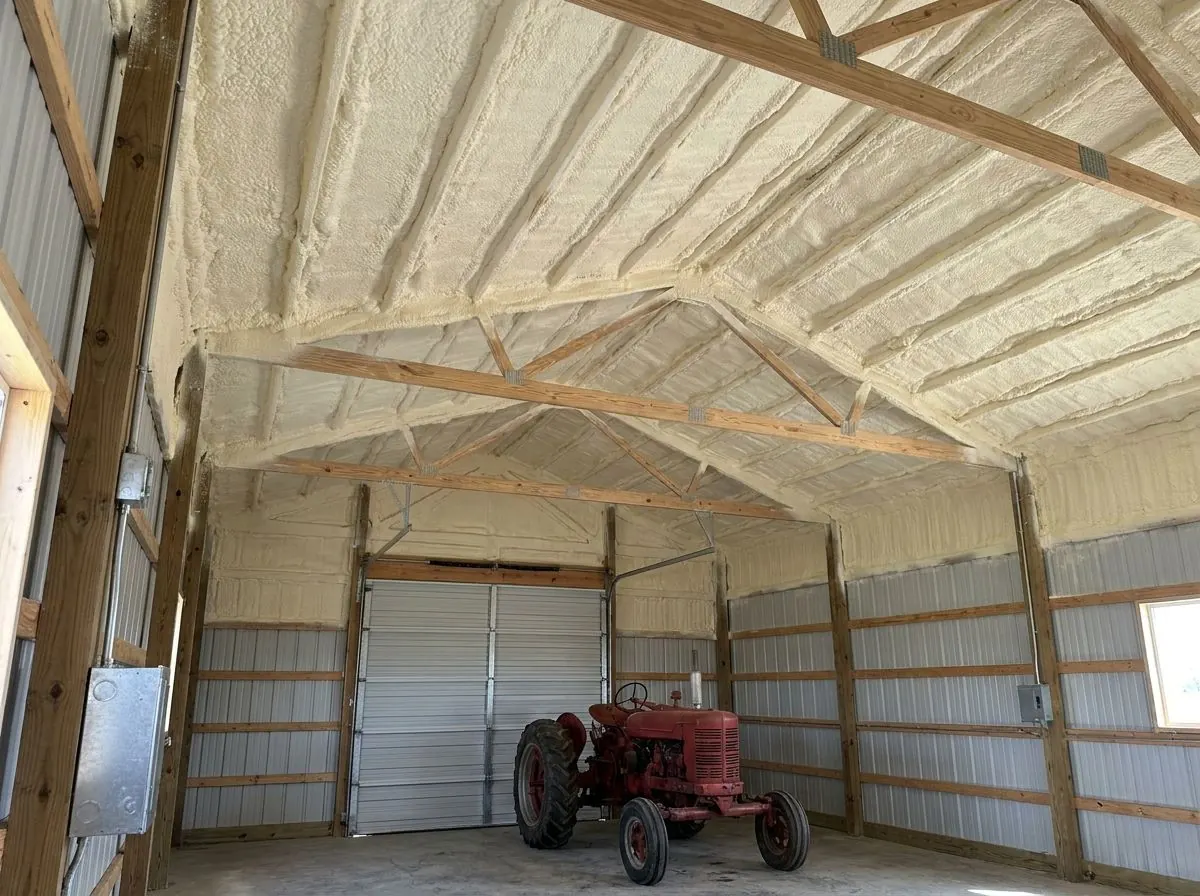
Closed-cell foam sprayed straight onto the back of the roof and wall steel seals the building from the inside. It adheres to the metal, fills the ribs and wraps the screw tips that otherwise frost over and drip in lines. The cold steel is no longer exposed to barn air, so the sweating stops at the source. The same pass air-seals the gaps along the eaves, where the wall steel meets the skirt board and around door frames, which cuts the drafts that make a heated shop so hard to keep warm.
Foam holds up to farm use better than loose batts. It is rigid, does not hold water, and gives birds nothing to pull out; rodents can still chew it, but they do not nest in it the way they do in fibreglass. Where the foam stays exposed, a listed intumescent coating is applied at the thickness the foam’s evaluation requires, or the walls are sheeted with steel liner or plywood to take impact from equipment and animals. Ventilation stays part of the design: foam removes the cold surface, not the moisture that animals and wet floors produce.
How the Job Runs, Step by Step
Walk the building with its use in mind
A machine shed, a heated shop and a horse barn need different answers. We look at the floor, the heating, the doors, the animals housed and how the building is ventilated now, and ask what the county and your insurer have said about the building. Rusted fasteners and roof leaks are flagged for repair before anything is sprayed.
Clear, clean and protect
Existing torn batts, poly, nests and droppings are removed. Rodent and bird droppings are wetted down and handled with respiratory protection because deer mice in Alberta can carry hantavirus. Equipment is moved out or covered, feed and hay are removed, and the steel is cleaned of dust and dried.
Heat the barn to spraying range
Foam needs steel and air within the manufacturer’s temperature window. In the shoulder seasons and winter that usually means temporary heat before and during the work, which is part of the plan for any Rocky View County farmyard job outside of summer.
Spray roof, walls and air leaks
Foam is applied in passes to the underside of the roof steel between purlins and to the wall steel between girts, with thickness checked as it goes. The eaves, the base of the wall and the frames of sliding and overhead doors get particular attention, since those are where wind drives in across open land.
Coat or cover, then air out
After the manufacturer’s re-entry period, commonly about a day, the specified coating is rolled or sprayed to a measured wet-film thickness, or liner panels go up where animals or equipment will contact the wall. Livestock return only after the building has been ventilated and the manufacturer’s guidance for occupancy is met.
What Decides the Specification
Heated or unheated is the first question. An unheated machine shed only needs enough foam to keep the steel from being the coldest surface, and sometimes a different fix is better. A heated shop kept at working temperature through January needs real R-value on the roof and walls, and the roof is where most of the heat goes. Livestock barns have their own balance: enough insulation to keep the steel dry and the animals comfortable, while the ventilation system still exchanges enough air to clear moisture and ammonia.
The finish is the second decision. Intumescent coatings are only accepted with specific foam products at specific thicknesses, so they are chosen with the foam. Walls in reach of livestock or loaders need a physical liner, because animals will chew and rub exposed foam and a bucket will gouge it. Some insurers have their own requirements for exposed foam in farm buildings, and those can set the finish regardless of what code treatment the county applies.
Alberta Code Notes
Alberta treats farm buildings differently from other buildings under the Safety Codes Act, but that difference depends on how the building is actually used. A barn used for farming may be handled one way, while a shop on an acreage used for a business, a hobby garage or a building with living space can be treated as a regular building under the National Building Code – 2020 Alberta Edition. Do not assume any exemption; confirm the building’s status with Rocky View County, or the town if the property is inside Crossfield or Irricana, and with your insurer before work starts.
Whatever the code status, the foam is still installed to CAN/ULC-S705.2 with its site records and field tests, and the thermal barrier or coating is still chosen from what the foam’s evaluation report accepts. That documentation is what an insurer or future buyer will ask for.
General guidance only. The authority having jurisdiction and the product’s own evaluation report decide what applies to your job.
Around Airdrie
Rocky View County wraps around Airdrie on every side, and the acreages and farmyards out toward Irricana and Crossfield hold a large number of post-frame barns, machine sheds and steel shops. Many are being converted from cold storage to heated workshops as owners move in equipment, start trades businesses or keep horses. Those buildings sit on open prairie with the west and northwest wind driving straight at them, and the repeated chinook thaws mean roof steel goes through cycles of frost buildup and melt that turn a minor sweating issue into a weekly drip.
Often Done Alongside
Commercial Bay & Warehouse Spray Foam
Closed-cell foam sprayed direct to steel decks and panels to stop condensation drip.
Detached & Heated Garages
Full thermal envelopes for detached and heated garages running gas unit heaters.
Intumescent Thermal Barrier Coating
Paint-applied intumescent barrier over exposed foam, matched to that foam's listing.
Where We Do This Work
Ag Shops: Questions We Get
Is spray foam safe to use in a barn with livestock?
Does a pole barn on an acreage need a building permit?
How thick should foam be on a pole barn roof?
Will spray foam keep mice out of my shop?
Can you insulate in the middle of an Airdrie winter?
Considering Ag Shops?
Call Airdrie Insulation or send the details. We will look at the job, tell you whether ag shops is the right fix, and price it in writing.