Mobile & Manufactured Home Insulation Around Airdrie: Belly Board & Skirting Repairs
Floors that stay cold no matter how high the furnace is set, water lines that freeze every January, insulation hanging in shreds under the home: these are the usual signs of a damaged belly and leaky skirting. We repair the underside of manufactured homes around Airdrie and seal out the wind.
The Problem It Solves
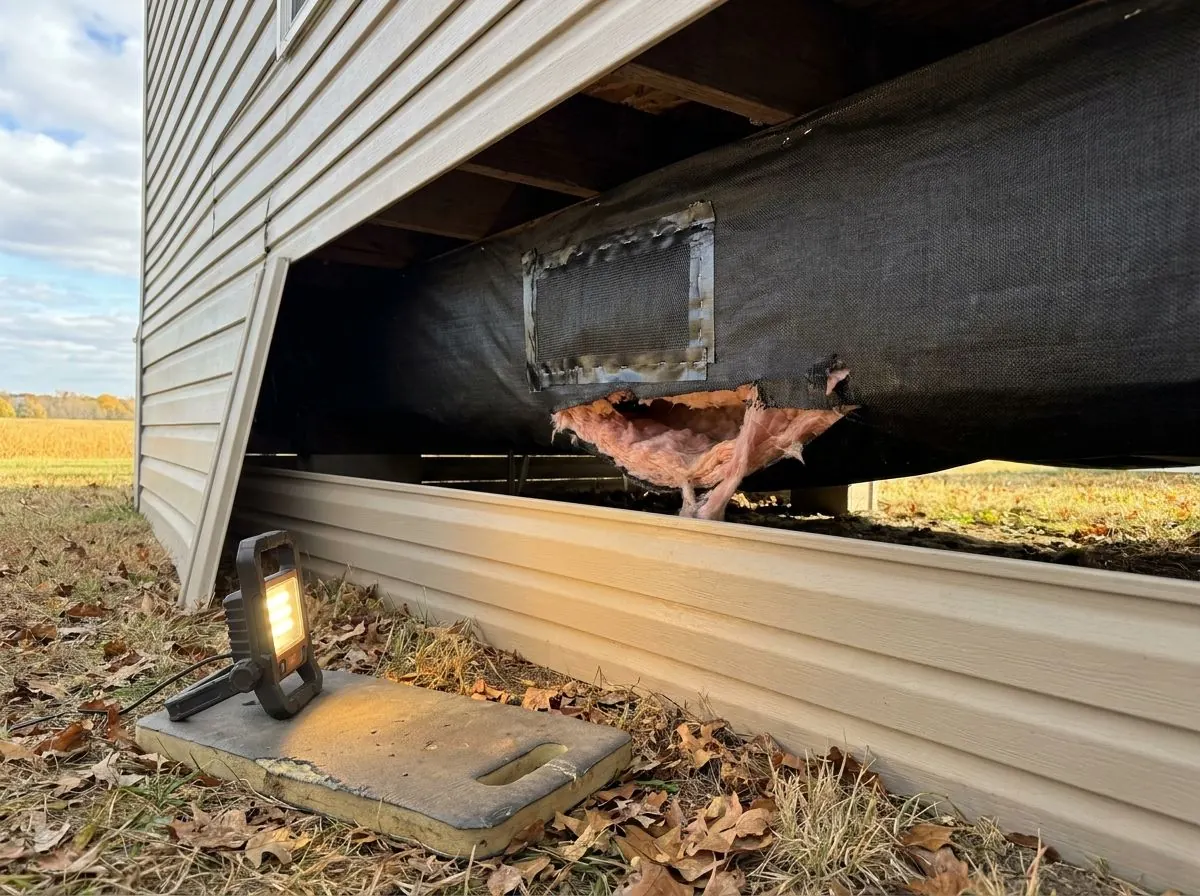
A manufactured home is insulated differently from a site-built house. There is no basement wall doing the work; insulation sits in the floor cavity and is held up by the belly board, also called the bottom board: a tough fabric or sheet stretched across the underside of the home. When that sheet is intact, the floor stays reasonably warm. When it is torn by wind, chewed through by mice, or cut open for a plumbing repair and never closed, the insulation sags, falls out, or gets soaked, and cold air runs straight across the underside of the floor. Owners feel cold floors and a furnace that never shuts off.
Frozen water lines usually follow. The water supply typically rises out of the ground into the belly, often protected by heat tape and a little insulation. Once the belly is open and the skirting leaks, the prairie wind pulls cold air under the home and across those lines, and the heat tape cannot keep up during a deep cold snap. A leak from a split line then soaks whatever insulation is left, which stays wet in the closed belly, grows mould and smells, and adds weight that pulls more of the bottom board down. One tear becomes a much bigger repair.
Skirting is the other half of the story. Skirting keeps animals out and slows the wind, but most of it is uninsulated and leaks at the ground, corners and panel joints. On multi-section homes, the crossover duct that carries heat between sections runs under the floor; if it has come loose or split, the furnace is heating the space under the home instead of the rooms. A dryer vent that ends under the skirting instead of outside it pumps warm, wet air into the same space.
How It Works
The fix starts under the home, not at the thermostat. We open or remove the damaged sections of belly board, pull out wet, sagging or rodent-soiled insulation, and check the plumbing, heat tape and ductwork while the cavity is open. The floor cavity is re-insulated with batts or loose-fill, and the belly board is patched with repair fabric and tape and fastened back to the frame and joists so it carries the insulation tight to the floor again. Large damaged areas get new material fastened across them, not a patchwork of tape.
Then we deal with the wind. Closed-cell spray foam, or rigid foam board where the skirting cannot take foam, seals the skirting perimeter at the ground line, the corners and the panel joints, cutting the cold air that sweeps under the home. We leave removable access panels and the skirting vents the installation calls for, keep foam off heat-traced lines, shut-offs and any part of the frame the manufacturer restricts, and keep or replace the moisture barrier on the ground so ground moisture does not rise into the belly. Loose crossover ducts and dryer vents ending under the home are flagged for repair.
How the Job Runs, Step by Step
Crawl the underside and map the damage
We inspect the whole belly from underneath: tears, sags, rodent entry points, wet spots, the water riser and heat tape, drains, crossover duct, dryer vent, ground cover and skirting. Where mice have been active, contaminated areas are marked for wet-down removal with respiratory protection and HEPA filtration, never dry sweeping.
Open, clean out and check what is hidden
Damaged belly board sections are cut open or taken down and wet or soiled insulation is removed and bagged. With the cavity open we look for plumbing leaks, failed heat tape and disconnected ducts. Those are repaired before anything is closed up.
Re-insulate the floor cavity
Fresh insulation goes back into the floor cavity, fitted up against the subfloor without voids and without being packed around heat-traced lines in a way the heat cable’s manufacturer does not allow. The water riser stays within the warm zone of the belly.
Patch and fasten the belly board
Repair fabric is cut to overlap sound material, taped at the edges with bottom-board tape, and mechanically fastened to the frame and joists so it carries the weight of the insulation. Rodent entry holes are closed.
Seal the skirting and keep the access
Closed-cell foam or rigid board seals the skirting at the ground line, corners and joints. Access panels stay removable and unfoamed so the water shut-off and riser can still be reached, and the skirting vents stay open as the installation requires. The ground moisture barrier is checked and repaired or replaced.
What Decides the Specification
The condition of the belly decides most of the specification. A home with a few rodent holes and one sagging section needs patching and local re-insulation. A home where the bottom board has failed along its length, or where years of small leaks have soaked the insulation, needs the damaged board and insulation replaced across the whole area. Duct layout matters too, including the crossover on multi-section homes. Homes on piers with tall skirting behave differently from homes set low to the ground.
The skirting material decides how we seal it. Thin vinyl skirting can distort under spray foam and becomes hard to remove, so rigid foam board lining with foam only at the ground line and joints is often the better choice. Metal and treated wood skirting take closed-cell foam directly. Skirting must also be able to move, because frost heave in the ground under an Airdrie winter can lift skirting that is rigidly locked to both the home and the soil. Around the water riser, heat tape type, the shut-off location and any manufacturer instructions for the home decide what can be insulated and what must stay clear.
Alberta Code Notes
Manufactured homes are built in a factory to the CSA Z240 series of standards rather than framed on site under Part 9 of the National Building Code – 2020 Alberta Edition, so the home manufacturer’s installation instructions carry real weight for the underside, frame and skirting. The authority having jurisdiction, whether the City of Airdrie, Rocky View County or a nearby town, decides whether a repair needs a permit, and plumbing, electrical or gas problems found go to licensed trades. Closed-cell foam on skirting is installed to CAN/ULC-S705.2, and heat tape instructions on what may cover the cable take priority over any insulation plan.
General guidance only. The authority having jurisdiction and the product’s own evaluation report decide what applies to your job.
Around Airdrie
Manufactured homes around Airdrie sit in a few distinct settings. Some are in established parks where homes are set close together and skirted low; others sit on Rocky View County acreages and rural lots near Crossfield and Irricana, fully exposed to open prairie on every side. The exposed homes take the brunt of the strong west and northwest winds, which is where skirting leaks and torn belly board turn into frozen lines. Rural sites also see mice from surrounding fields, and one winter of nesting can ruin a belly.
Often Done Alongside
Crawl Space Encapsulation
Reinforced ground liner plus closed-cell foam on crawl space walls and rims.
2lb Closed-Cell Spray Foam
2 lb foam: insulation, air barrier and vapour control for concrete and rim joists.
Thermal Imaging & Draft Audits
Infrared scans to find leaks and gaps, with before-and-after images.
Where We Do This Work
Mobile Homes: Questions We Get
What is the belly board on a mobile home, and why does it matter?
Can you spray foam the whole underside of my manufactured home?
Why do my mobile home water lines keep freezing even with heat tape?
Is it safe to remove mouse-damaged insulation from under a mobile home?
Do I need a permit for insulation work?
Considering Mobile Homes?
Call Airdrie Insulation or send the details. We will look at the job, tell you whether mobile homes is the right fix, and price it in writing.