Insulating Ag Shops, Pole Barns & Acreage Homes Across Rocky View County
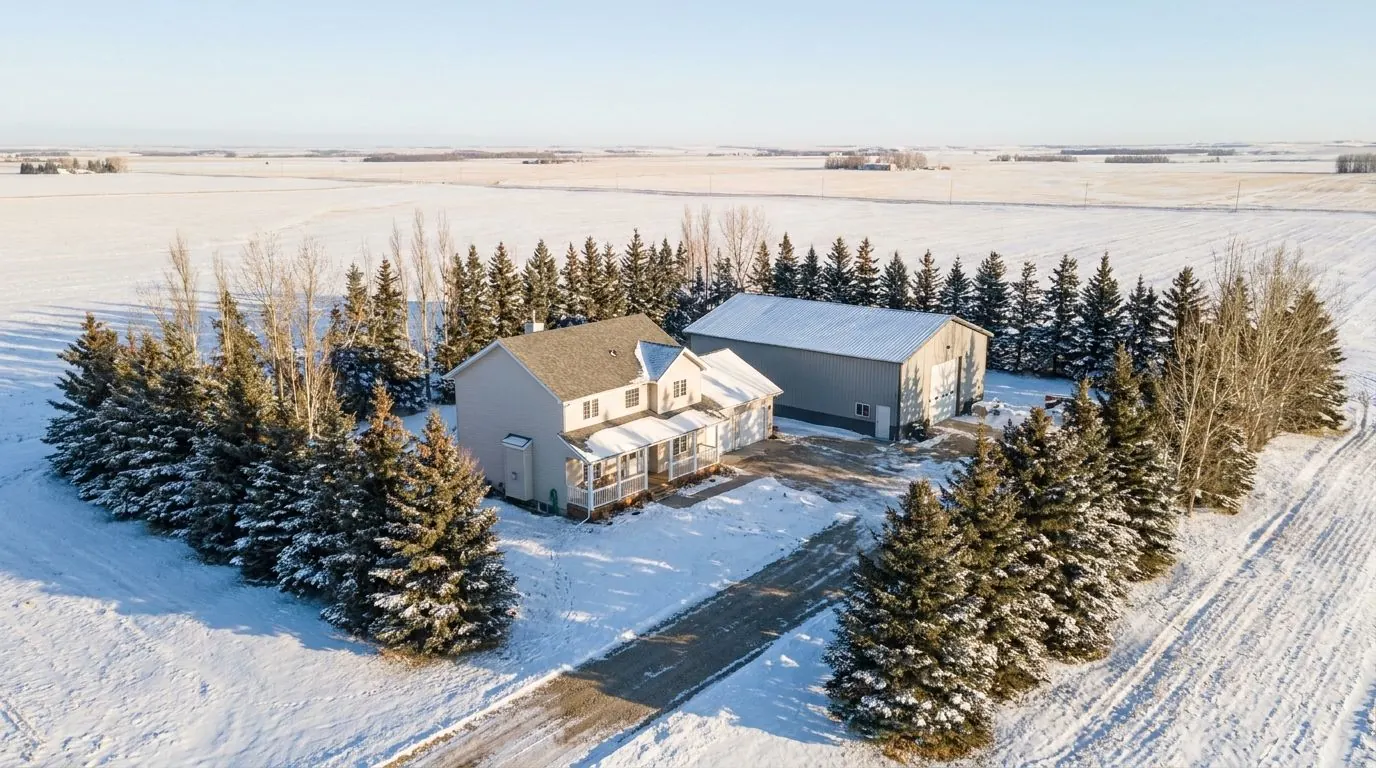
Farmyards and acreages around Airdrie, Crossfield and Irricana sit on open prairie where the wind has nothing to slow it down. The buildings take the brunt: steel-clad pole barns that rain condensation onto equipment, shops that cost a fortune to heat, and acreage homes whose attics were insulated decades ago.
We insulate ag shops, pole barns, heated equipment buildings and rural homes across Rocky View County. Most of the work is closed-cell foam on steel and blown insulation in attics, and nearly all of it starts with working out where the moisture and the cold air are coming from.
Sweating roof steel
Post-frame and steel-clad buildings drip when warm, damp air meets cold roof steel, and the water rusts fasteners and lands on whatever is parked below. Closed-cell foam sprayed to the steel stops the air reaching it and adds a continuous layer of insulation.
Birds and rodents
Exposed batts and faced blankets in farm buildings get pulled apart by birds and nested in by mice. Foam bonded to the cladding holds up far better. Where rodents have already been in insulation, removal is done wet, with respiratory protection and HEPA extraction, because deer mice can carry hantavirus.
Livestock buildings still need air
Animals produce a lot of moisture and ammonia. Insulating a barn without keeping or improving its ventilation trades a drip problem for an air quality problem. We look at how the building breathes before we seal anything.
Heated shops
A shop with a unit heater or an in-floor system loses most of its heat through the ceiling, the overhead door and the slab edge. Foam or flash-and-batt on the walls and roof, rigid board under a new heated slab, and attention to the door openings all pay back in how long the heater runs.
Coatings instead of liner panels
Exposed foam in a shop generally needs protection. Where a steel liner or drywall is impractical, an intumescent coating tested with that foam may be accepted. What the building needs depends on its use and on what the county and your insurer require.
Acreage homes
Older rural homes often have thin or settled attic insulation, wind-washed insulation at the eaves and draughty rim joists. Air sealing, baffles and a blown top-up are usually the first and best-value fix, and a thermal camera on a cold morning shows where to start.
Before we quote a farm building
- What the building is used for: equipment, livestock, a heated workshop, or storage
- How it is heated and ventilated now, and whether that will change
- The cladding and framing, and whether the steel is clean and dry enough for foam to bond
- What the county and your insurer expect for this building, which you should confirm with both
- Whether we need temporary heat on site so the foam can be sprayed within the manufacturer’s temperature limits
Services That Come Up Most
Pole Barns & Agricultural Shops
Closed-cell foam for post-frame barns and ag shops to stop steel sweating and drip.
2lb Closed-Cell Spray Foam
2 lb foam: insulation, air barrier and vapour control for concrete and rim joists.
Intumescent Thermal Barrier Coating
Paint-applied intumescent barrier over exposed foam, matched to that foam's listing.
Detached & Heated Garages
Full thermal envelopes for detached and heated garages running gas unit heaters.
Sub-Slab Rigid & Spray Insulation
Rigid board or high-density foam under radiant slabs, installed before the pour.
Blown-In Cellulose Attic Top-Ups
Borate-treated cellulose blown over old attic insulation toward about R-60.
Attic Air Sealing & Penetration Proofing
Hand-sealing stacks, wiring holes, top plates, fixtures and flue chases.
Thermal Imaging & Draft Audits
Infrared scans to find leaks and gaps, with before-and-after images.
Farms & Acreages: Questions
Can you spray foam a shop in winter?
How far out from Airdrie do you travel for farm work?
Is foam worth it on a cold storage building?
Also see
Got a shop that drips or a barn that will not hold heat?
Call with the building size, cladding and how it is used, and we will tell you whether foam, batts or ventilation is the right place to start.